Are my angel investments beating the market? Today, I crunched the numbers to find out. TL;DR: I’m at a 25% IRR.
This beats stocks by a large margin.
Let’s back up a little. What does this number mean, and how did I calculate it?
What Is IRR?
To know if I’m beating stocks, I have to calculate my Internal Rate of Return, or IRR. This number shows my annual percentage gain.
Let’s take a simple example…
You invested $10,000 on January 1st, 2024. On January 1st, 2025, the company was acquired and you got back $20,000.
Your IRR is 100%. In other words, you doubled your money in a year.
How IRR Works In My “Fund”
When you add more investments, things get more complicated. But it’s the same idea: figure out when I invested, when I exited, and derive a rate of return.
Most of my investments have not exited yet. For those, we use their current valuation and a date of today.
I am very conservative about valuations. I only mark up a company when they raise a new priced round, not when they raise a SAFE at a higher price. This is how the top VC firms operate.
I also accounted for the likely fees in my syndicate investments and for any dilution thus far.
What Data Do We Need?
I keep a spreadsheet of all my investments. This is the info I need for the IRR calculation:
- Date investment made
- Amount
- Exit value of investment (if exited)
- Date of exit
- Current value of investment (if not exited)
For this calculation, we’ll look at my “Fund 1” of 35 companies. This is a typical number of companies for a venture fund. “Fund 1” includes investments made from June 2021 to August 2025.
Crunching The Numbers
I used Grok 4 Expert to crunch the numbers for me.
You can also use the XIRR function in most spreadsheet programs. But I like the step-by-step, carefully explained work that Grok does, so I went with that.
I fed Grok a spreadsheet with the data I mentioned above. Now, the moment of truth…
Grok found a 24.7% IRR!
Beating the Market
A 25% IRR beats the market handily. And it better — investing in startups is risky and illiquid!
The S&P 500 has averaged a 10% annual return in data going back to 1957. The NASDAQ Composite has hit an 11% return over the last 20 years.
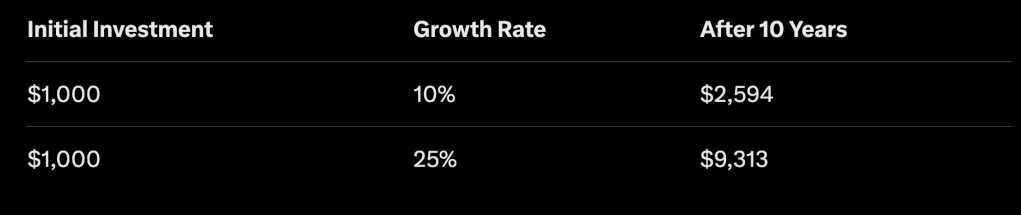
The difference between a 25% IRR and 10% has a huge impact over time.
If you invest $1,000 at a 10% growth rate, you have $2,594 dollars in 10 years. Invest that same $1,000 at a 25% growth rate, and you have $9,313, or 3.6 times as much.
Wrap-Up
I was really surprised my results were this good!
There’s a huge caveat here: this IRR is based on paper gains. Converting paper gains to actual cash isn’t easy.
But for a portfolio that’s only a little over 4 years old, this is great progress.
Now, time to meet more founders and find that next great investment…
More on tech:
How My “Fund” Is Beating Over 90% of VC’s
Yes, You Can Angel Invest $5k Direct
Meet My Latest Investment: Memelord
Save Money on Stuff I Use:
This platform lets me diversify my real estate investments so I’m not too exposed to any one market. I’ve invested since 2018 with great returns.
More on Fundrise in this post.
If you decide to invest in Fundrise, you can use this link to get $100 in free bonus shares!
I’ve used Misfits for years, and it never disappoints! Every fruit and vegetable is organic, super fresh, and packed with flavor!
I wrote a detailed review of Misfits here.
Use this link to sign up and you’ll save $15 on your first order.


Leave a Reply