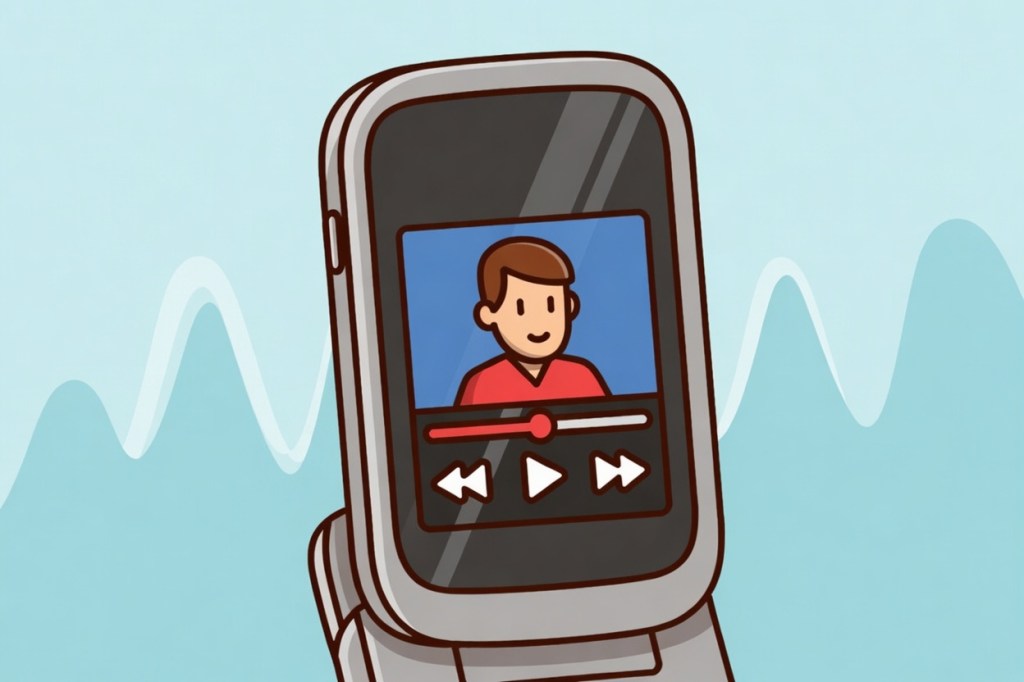
If you’re old enough to have had a flip phone, you probably remember that images looked terrible on that tiny screen. But a friend of mine, Jesse Bray, figured out how to stream HD video to those little screens as early as 2005.
How he did it is the story of today’s guest post. Enjoy!
We Tried to Beat YouTube — and Streamed HD Video on a Motorola Flip Phone
In 2005, I worked for a startup that was trying to compete with YouTube.
We also had an algorithm that could stream HD video on a Motorola flip phone.
Yes, actual HD.
On a flip phone.
That is usually the point where people assume I am exaggerating.
I am not.
The company was called Alpha Omega, and the entire experience now feels like a half-remembered fever dream from the early internet: a wealthy, eccentric Italian investor, two young musicians from Portland, a trip to Mesa, Arizona, a prototype for an all-in-one handheld device, public-domain movies, sock puppets, and the sincere belief that we were building the future of media.
Somehow, all of it really happened.
How We Ended Up in the Room
My roommate, best friend, and bandmate was working on Alpha Omega with me.
We met the investor through my mother, who had worked as a model and actress and seemed to know an endless supply of unusual and fascinating people.
The investor was a wealthy Italian man with a diplomatic or ambassadorial air about him. Even now, I am not completely sure how to describe what he had going on. He seemed to exist somewhere between international businessman, patron of ambitious young people, and character from a movie nobody else had seen.
He was spearheading Alpha Omega and eventually flew us from Portland to Mesa, Arizona, to help work on it.
We were not famous engineers.
We were not seasoned founders.
We were young musicians who had somehow gotten into the room.
But the room was doing real things.
We Were Building for a Future That Barely Existed
Online video in 2005 was still awkward.
Bandwidth was limited. Video quality was unreliable. Mobile phones had tiny screens, weak processors, little storage, and internet connections that felt almost ceremonial.
YouTube had only just launched.
Most people were not yet carrying devices designed to stream video all day. The idea of watching high-quality entertainment on a phone still felt futuristic.
Alpha Omega was trying to change that.
We had an algorithm capable of streaming HD video on a Motorola flip phone.
That was the magic.
It was not a sketch, a pitch-deck claim, or a prediction about what might eventually be possible.
We did it.
Watching high-definition video appear on that tiny device felt completely absurd. The hardware looked incapable of supporting the experience, yet there it was.
Today, streaming video on a phone is invisible technology. Nobody thinks about it.
In 2005, it felt like science fiction.
Naturally, We Also Designed a Device
We were huge Star Trek nerds, so merely building a streaming platform was not enough.
We also mocked up an all-in-one handheld product called the Alpha Omega Device.
It would function as a:
- Phone
- Music player
- Video player
- Calculator
- Internet device
This was before the iPhone had been announced.
No, we did not invent the smartphone.
We did not manufacture the device, and Steve Jobs was never forced to call an emergency meeting about us.
But we were imagining the same convergence that would soon transform everyday life: communication, media, music, computing, and the internet all collapsing into a single object people carried everywhere.
Our name may have lacked Apple’s elegance.
Our ambition did not.
Our Streaming Service Had Sock Puppets
Alpha Omega also created a streaming platform featuring public-domain films.
We were trying to compete in the emerging online-video world, but we did not have the money to license a major Hollywood catalog.
Public-domain movies gave us something legitimate to stream.
The problem was that old public-domain films were not exactly an unstoppable viral-marketing strategy.
So we made sock-puppet parodies of them.
Each film had a ridiculous puppet version designed to make fun of what the audience had just watched.
It was cheap, strange, and memorable.
More importantly, it was our attempt to create original content around a larger media library — to give people a reason to share the platform rather than simply use it.
Long before every company had a “content strategy,” we were trying to build one out of old movies and socks.
I Was Also Trying to Become a Folk Singer
At the same time, I was fronting the Jesse Bray Band and trying to become some version of a folk and indie singer-songwriter.
I was not exactly a major star.
But I was in the room, and the room occasionally did things.
Through my mother, I was connected with a sitcom pilot and wrote a theme song for it called “I’ll Take You Back.”
The pilot never went anywhere, which is the fate of most pilots, but I recently rescued the song from the archives.
Listen to “I’ll Take You Back” on Apple Music
That part of my life mattered to how I viewed Alpha Omega.
I did not see online media only as a technology problem.
I saw it as a creator problem.
I Thought YouTube Might Become Video’s Napster
Napster had already demonstrated how quickly technology could transform an industry.
It made music nearly frictionless for audiences while creating chaos for the musicians, labels, and businesses that depended on controlling distribution.
When YouTube appeared, I saw enormous potential.
I also saw another Napster.
I worried that filmmakers, animators, musicians, comedians, and small independent creators would generate the value while a centralized platform controlled the audience, the discovery system, and eventually the economics.
I was young, earnest, and probably a little too convinced that I could become a folk hero for the little creators.
But the concern was not entirely wrong.
Who controls distribution?
Who owns the audience relationship?
Who benefits when creative work travels farther than ever?
What happens when a platform becomes more powerful than the people whose work made it valuable?
Those questions became central to what is now called the creator economy.
We were asking them before the creator economy had a name.
We Saw the Future, but We Did Not Own It
Alpha Omega did not defeat YouTube.
We did not launch the Alpha Omega Device.
Our public-domain streaming service did not become a global destination.
The sock puppets, tragically, did not become entertainment icons.
But we saw several things clearly.
People would watch video online.
They would stream it on phones.
Music, video, communication, and computing would converge into a single handheld device.
Original creators would become essential to the growth of digital platforms.
And those creators would spend the next several decades struggling over ownership, compensation, reach, and control.
Seeing the future, however, is not the same as building the company that owns it.
Timing matters.
Capital matters.
Distribution matters.
Leadership matters.
Execution matters.
And sometimes you can be standing directly in front of what comes next without having the resources, structure, or luck required to carry it into the world.
What stayed with me was not the belief that we had secretly invented YouTube or the iPhone.
We had not.
What stayed with me was the experience of being invited into a room where people were sincerely attempting things that sounded impossible.
We were streaming HD video on a flip phone.
We were imagining an all-in-one media device.
We were building a streaming platform around public-domain films and sock-puppet comedy.
We were trying to protect small creators while simultaneously convincing ourselves we might become successful musicians.
It was messy, ambitious, ridiculous, and real.
I may not have been the most accomplished person in that room.
But I was there.
And the room did stuff.
That may be one of the most important lessons of my career.
Sometimes your first great opportunity is not being the genius who controls the room.
It is simply getting inside, paying attention, contributing what you can, and allowing the impossible things happening around you to permanently expand your sense of what can be built.
-Jesse Bray
I hope you enjoyed this story from my friend Jesse! We’ll be back to our regularly scheduled programming tomorrow.
More from the blog:
Gemini Drops Its Fastest, Cheapest Models Ever — Time to Cut Your Token Costs?
Ghosted by a VC? Here’s What to Do.
I Built a Meeting Prep Agent That Saves Me 30 Minutes a Day — Here’s How You Can Use It Too
Save Money on Stuff I Use:
This platform lets me diversify my real estate investments so I’m not too exposed to any one market. I’ve invested since 2018 with great returns.
More on Fundrise in this post.
If you decide to invest in Fundrise, you can use this link to get $100 in free bonus shares!
I used this app every single day to dictate to my computer, I’m even dictating this text using Wispr Flow! It’s way better than Apple’s native dictation.
My productivity is up about 25% since I started dictating rather than typing. I’m also less tired and stressed.
Get a free month of Wispr Flow Pro here!


Leave a comment