It’s been a quiet 2025 for me investment-wise. But every once in a while, you see something truly exceptional. Sent.dm is exactly that.
Sent is an API to send messages to whatever platform your customers prefer – iMessage, WhatsApp, RCS, SMS and more.
Sent can save you 80-90% on your messaging costs.
For even some midsize startups, these costs can run to hundreds of thousands of dollars a month. That can represent a double-digit percentage of their revenue.
If Sent can save you that kind of money, why not try it?
This is exactly what I’m looking for in a startup: a clear value proposition. Sent takes costs and deletes them. Simple, compelling.
When I met with founder Daniel Vataj, I found him to be incredibly transparent and forthright. Folks like that inspire confidence in investors and customers alike.
No wonder Sent is growing really fast. If you have an application that sends text messages to customers, check it out and save yourself some money!
Lots of founders mess up calculating their Total Addressable Market (TAM). Here’s how to do it correctly…
Calculating TAM Correctly
You need to do what’s called a bottoms-up TAM. Take the number of potential customers and multiply that by what you charge for your product.
The figure you get is your bottoms-up TAM.
Let’s take an example: you’re making software for accountants.
Grok 3 tells me there are 1.4 million accountants in America. Your product costs $1,000 a month.
This gives you a bottoms-up TAM of $16.8 billion.
That’s a TAM that would get me excited! A SaaS company with even $100 million a year in revenue is worth a lot, likely over $1 billion. With $16.8 billion in potential revenue up for grabs, we have a chance to do very well.
How Founders Get It Wrong
Now, let’s look at how founders screw up the TAM calculation.
Too often, founders do a top down TAM, or what I call a lazy TAM. They just pluck a number from a report and use it as their market size, even when the number has no relevance to their startup.
For example, IBISworld says the accounting industry is a $140 billion industry. So, that same accounting SaaS startup could stick that $140 billion figure in its deck like it means something.
It doesn’t.
That market size includes salaries for accountants and all sorts of other costs. That figure doesn’t mean anything as far as how much money you can make selling your accounting software.
Wrap-Up
When you pluck a meaningless number from a report, you lose credibility.
When you calculate your TAM correctly, you show investors that you know what you’re doing. You understand your market.
Founders are using AI to build incredible products. And now, I’m using it to evaluate their businesses. Here’s how…
When I was researching a startup in the past, I had to Google a hundred things and hope I’d find the right info. Team, possible competitors, market size, you name it.
Now, I have AI do most of it for me. Here’s my process:
1) Summarizing the meeting. I use Fathom to record, transcribe and summarize my meeting with the founder.
It’s incredible to be able to pull the transcript and summary whenever there’s a detail I can’t remember. It’s like having the founder right there with me throughout my research.
2) DeepSearch. I use Grok 3 DeepSearch to find every possible piece of information on the startup.
Grok routinely searches over 100 websites. I’ve found non-public sections of a startup’s website showing job openings, etc. These can tell you a lot about what’s going on at a company.
3) Reviews. Next, I look for any reviews or mentions of the startup’s service. DeepSearch is great for this too.
Do customers like it? What issues are they having?
4) Competitors. I also have DeepSearch look for any competitors the startup may have. Grok does a great job of summarizing what those competitors do.
This used to take endless Googling. I always dreaded it. But now, it’s incredibly easy and finds more than I ever did anyway.
5) Evaluate. Finally, I give Grok every piece of info I have on the startup, based on my research.
I prompt it “You are the world’s greatest angel investor. Do you want to invest in this startup?”
For this part, I use the Think function. This lets Grok take more time to self-prompt and come up with a great answer.
So far, Grok has agreed with me on what investments to make.
I’m not going to slavishly do what an AI tells me, though. Grok’s answer is just one data point among many.
Wrap-Up
I estimate that researching an investment takes me 30% less time with AI. I also get perhaps 50% more relevant information.
This research use to be a really painful process. Umpteen Google searches, reading through product reviews until my eyes pop out of my head.
It’s incredible how much easier it’s gotten in just the last year. I simply point Fathom and Grok in the right direction and they bring me all the info I need.
If you’re an investor, AI could make your work a lot easier. And if you’re a founder, AI could help you find competitors early.
Give it a try!
There will be no blog tomorrow. I’ll be at a conference.
Everyone’s talking about ChatGPT, Claude and Grok. But there’s another competitor creeping up the charts: Qwen from Alibaba.
Most people haven’t tried it. So today, I decided to see if this model can compete with the best from America.
I used the new 32B model and fed it the same prompts I recently used to test Grok 3. Let’s see what this puppy can do!
1) Qwen, My New Investment Analyst. My first test is a tough one: helping choose an asset allocation for my stocks.
Here’s the prompt I used:
“Assume I have a portfolio of index funds. My goal with this portfolio is long term growth. How should I allocate this portfolio across different types of index funds? Consider options like US index funds, foreign stock index funds, etc. I am 39 years old, so my time horizon is long. My risk tolerance is high. What would be the best allocation, given all this information? Use the best research you can find to support your answer.”
I turned on “Search,” just like I did for Grok. Here’s what Qwen gave me…
Qwen recommended a portfolio tilted heavily to the US. This is at odds with research Grok cited, showing that the world stock market is split 60/40 between US and foreign by market cap.
What Qwen is recommending is risky and doesn’t make much sense. Perhaps this is because it only looked at 9 sources, as opposed to 40 for Grok 3.
I’m giving this response a C.
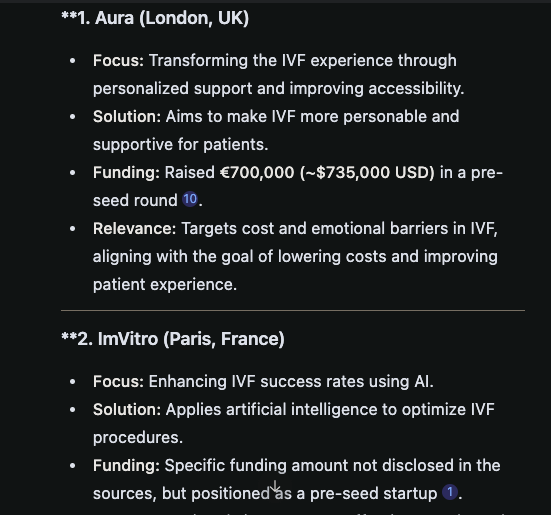
2) Qwen, The Startup Finder. Next, I used Qwen to search for startups in areas I’m interested in. Maybe I’ll get a new investment out of this!
Here’s the prompt:
“What are the most interesting startups at pre-seed stage working on solutions to increase fertility? Consider startups to lower costs and improve effectiveness of IVF, and also startups to improve egg health for older women, among other possible ways to boost fertility. Please only show me startups that have raised $750,000 or less in funding.”
Again, I used the “Search” function. Let’s see what Qwen can do:
Qwen popped up some cool startups. But when I searched them on Crunchbase, they had raised a lot more than $750k. This means they’re too late stage for me.
So, Qwen’s result wasn’t useful. Grok had some of the same problems, but it found at least a few startups that met my criteria.
I’m going to give this round a C as well.
3) Coach Qwen. Finally, I asked Qwen to help me perform better in my founder meetings.
Here’s the prompt I used:
“As an angel investor, I meet with a lot of startup founders. I want to do the best job I can in those meetings. What are some tips to perform better, be more helpful, and learn more about the startups I meet with?”
I turned off the Search for this one, since it shouldn’t require a ton of sources. Here’s what Qwen gave me:
Qwen’s response is solid. It told me to thoroughly prepare and to spend most of my time listening to the founder.
These are things I already try to do, but it’s good to have that reminder.
However, Qwen’s response was not as insightful as Grok’s. Grok told me to watch the founder’s body language and to question his key assumptions, both great suggestions.
Qwen’s response felt a little more obvious and generic than Grok’s. So, I’ll give it a B here.
Wrap-Up
Qwen does great on benchmarking tests. But in real world use, I came away unimpressed.
Overall, I’m giving it a C+.
It’s a serviceable model that does an okay job of answering questions. But Grok or ChatGPT give better answers.
I’m sticking to Grok 3 as my homepage and main LLM. It will take something really special to dethrone it.
Yesterday, I drove a car for the first time in 8 years. This Tesla Model Y was so awesome that it taught me a lot about product design.
I absolutely detest driving. One of the main reasons I live in the NYC area is so that I never have to get behind the wheel.
But on a camping trip this weekend, my friend was so excited about his new Model Y that I got curious…
Thoughtful Design
He opened the backdoor and showed me the interior. He’d bought the foam mattress that turns the back of the car into a bed.
“It’s more comfortable than the one I have at home!” he said. “I put the car on camp mode and it was 67 degrees all night. It only cost me 16 miles of range.”
Keep your heat on in a gas car and you’ll soon have a dead battery. But not on this electric spaceship.
“I charge it between 9am and 7am for half price,” my friend continued.
Immediately, I imagined having to leave the house every day at 9pm and plug the car in. Unless…
“Is there a way to have charging turn on at the right time?” I asked.
“Yep, it does that automatically,” he responded.
Wow, these guys truly thought of everything.
Word of Mouth Wins
Don’t want to leave your house to plug the car in? Schedule it in the app. Want to enjoy the woods without freezing solid? Put it on camp mode.
Tesla has taken every conceivable pain point and solved it, proactively.
And best of all, their salesman is unpaid!
There’s no ad Tesla could buy that would be as convincing as a friend telling you they love their new car.
But driving is believing. It was time to try this puppy out…
Taking It On the Road
I wasn’t sure I even remembered how to drive. So I had my buddy put the car in “Chill Mode.”
Slowly, tentatively, I creeped down an empty woods road…
I couldn’t believe how smoothly it accelerated. Instantly and silently, I went to whatever speed I wanted.
The visibility was incredible, unlike any other car I’ve driven. That made driving feel a lot safer.
My favorite feature was how it stops. All I had to do was take my foot off the gas…err…accelerator and the car rolled to a stop. No brake needed and no creeping.
Wrap-Up
Driving has always scared me a little. In a split second, things can go terribly wrong.
But even with an 8 year hiatus, I felt safer driving the Tesla than any car I’ve ever tried. I was also amazed at how every aspect was perfectly designed, from climate control to charging.
If Tesla can get someone like me behind the wheel, they must be doing something right!
So, am I going to buy one?
Since I live in a very walkable neighborhood where parking can be tough, it doesn’t make sense at the moment. But I can’t wait to tool around NYC in the new Cybercab!
Tesla shows us how to work backward from a great customer experience. They’ve anticipated every problem and solved it.
And because the customer experience is so good, Tesla owners are their best salesman.
Try to make an incredible experience for your customers, like Tesla does. If you can nail it, the marketing takes care of itself.
I play with different products every day — some for investment research, some just for fun. Here are my current favorites:
Meetings: Google Meet. So much better than Zoom!
No software needed and instant boot-up means I’m never late for a call. I also love that it has the time on the screen so I can always see it, even in fullscreen mode.
YC founders are early adopters and Google Meet has a nearly 100% market share there, if my meetings are any indication. That should tell us something.
LLM: Grok 3. Best LLM I’ve used so far.
The DeepSearch is incredibly powerful. It scraped 91 websites in less than a minute for some investment research I was doing yesterday. It even found nonpublic sections of a startup’s website, which gave me some very useful info.
Browser — Brave. I like Brave for the same reason I like Google Meet — clean design and strong performance. Everything moves faster in Brave.
When you save a fraction of a second over and over, perhaps hundreds of times a day, it really adds up. Brave also does a great job of protecting your privacy.
Notetaker: Fathom. I’ve tried just about all of them, and Fathom is the best.
It doesn’t just take notes on your meetings. It records the entire thing so you can re-watch it!
I just used that yesterday as part of some investment research I was doing. It’s incredibly helpful.
It also creates a full transcript and helpful summaries. It even tells me how much I’m talking and if I went on any monologues.
Best of all, there’s even a free tier that lets you record as many meetings as you like. I strongly suggest trying it!
Laptop: Macbook Air. Absolutely bulletproof. I doubt I could break this thing if I tried.
The one I’m typing on right now is 12 years old!
I recently used a brand new one at Best Buy. Other than it being a different color, I couldn’t tell any difference. That’s how well these hold up.
It also gets great battery life, looks pretty, and weighs next to nothing. It costs a bit more than a Windows or Chrome machine, but you’ll make it back in durability.
Desktop: Mac Mini. Just got one of these to replace my long-suffering Linux box. Like the Macbook Air, it’s incredibly sturdy and reliable. It also looks nice, which doesn’t hurt!
Messaging App: Signal. It’s encrypted and open source, so you know there’s no backdoor built into it.
WhatsApp and iMessage are not open source. And in the case of WhatsApp, I really don’t trust Facebook with my data.
Signal also has a ton of cool features. I can edit or delete a text if I made a typo. And I get a ton of use out of the “note to self” function.
Wrap-Up
When we have the right tools, we’re happy and productive.
All of these tools are reliable, cleanly designed, and easy to use. That’s what every product designer should aim for, whether you’re at Apple or a tiny startup.
“For two decades, no Secretary of Defense even bothered to set foot in Silicon Valley…” In 2015, Ash Carter finally changed that. This was the beginning of a wave that launched a thousand defense startups.
In 2016, Raj Shah and Christopher Kirchoff took control of Defense Innovation Unit X (DIUx). Their mission was to bring the military into the modern era. Shah and Kirchoff tell the fascinating story in the book Unit X.
Embrace the Suck
When Shah and Kirchoff took over, many defense systems were ancient.
The fighter planes Shah flew in Iraq didn’t even have a map to show where he was. So he brought a tablet and strapped it to his leg!
It’s an insult to our soldiers to make them go to war with materiel like this. But Shah and Kirchoff were determined to change it.
From day one, the Pentagon and Congress did everything they could to kill Unit X. A Pentagon agency froze their credit cards so they couldn’t pay for travel.
The red tape came down to two things: turf battles and mindless rule following.
Many in Washington feared this new agency would take away their power. Others followed rules to the letter without considering the intent of Secretary Carter or the President.
This is a recurring problem in our government. We hew to mechanical systems of rules and don’t let people use their judgment.
What we need to do instead is put good people in charge, give them a goal and a budget, and tell them to use their best judgment.
Moving at Silicon Valley Speed
In time, Shah and Kirchoff managed to get some contracts out the door. Many were paid pilots. If the startup delivered a prototype, they’d get a bigger contract.
The key was to move fast. If Unit X took years to release money, startups would run out of runway in the meantime.
Crucially, a young analyst named Lauren Bailey found an obscure provision in the massive National Defense Authorization Act (NDAA). It allowed Unit X to sidestep the usual years long procurement process and do it in months.
This was the key to allowing the Pentagon to work with startups. Bailey might make an excellent Secretary of Defense some day!
Soon, Unit X was dispensing big sums to innovative young companies.
Capella Space got $10 million over 18 months for its satellite imaging systems. This cash came from hitting milestones, not just completing the final product.
Unit X’s budget ballooned, creating the wave of defense startups we see today.
Lessons for Startups
These days, if you’re making a product the DoD wants, you can get a contract in a timely fashion. Castelion, a hypersonic missile startup, got a military contract within months of raising their first venture capital.
Right now, the Pentagon is heavily focused on China, Taiwan, Russia and Ukraine. If you have a product that could help in those theaters, your chances of landing a contract should be better.
The DoD is also interested in AI systems to analyze conflicts. It’s wonderful that the world has seen fewer large scale wars in recent decades, but one side effect is that AI systems lack data about conflict.
World War II is incredibly well documented. The Nazi regime in particular had a way of recording everything.
If we could get that data into machine readable formats, new AI models might produce valuable insights. That’s a startup I’d love to see.
Wrap-Up
Years ago, the Pentagon was impossible to deal with. It would take them years to decide if they wanted to buy your product — time you don’t have.
Those days are over.
Shah and Kirchoff’s work will one day be viewed as a turning point for our military. They taught the DoD how to work with startups.
This lets our military get the newest and best technologies instead of whatever slop the Primes cook up.
If you’re an ambitious founder, I encourage you to make weapons that will keep our country safe. It’s one of the most important things you could do with your life.
And if you have something great, send me the deck!
“I’ve come to get what’s mine,” Hetty Green told the bank president. Her entire $25 million fortune was on the line as the bank neared insolvency. And Hetty wasn’t about to take a loss.
Hetty prevailed, as she did in so many deals. When she died in 1916, she left a fortune worth between $2.7 and $5.4 billion in today’s dollars.
That made her the richest woman on earth.
Growing Up Hetty
Hetty’s father, the owner of a large whaling business, had poor vision. So from a young age, Hetty read him the financial news.
For hours on end, day after day, she read to him. During those years, Hetty absorbed an enormous amount of information about financial markets.
When her father died, he left her a large estate. But although she had been his right hand for years in business, he tied up all the money in a trust. He didn’t trust her to manage the estate because she was a woman.
But Hetty was determined to prove herself. She took the income from the trust and started investing.
A Fortune Forged Alone
Hetty’s first investment was in US government bonds.
They were trading at half their convertible value in gold. Markets were betting that after the Civil War, the US could never pay the massive war debt.
Hetty bet the other way. She knew the nation’s vast natural resources would help guarantee the bonds.
Hetty didn’t care what other investors thought. She used her own judgement. From the excellent Charles Slack biography, Hetty:
“Where other investors sought the safety of numbers, the soothing ring of consensus, Hetty felt most comfortable on her own, trusting her own judgment and instincts.”
In time, the US made good on its obligations and Hetty made a fortune.
The Queen of Wall Street
One of two apartment buildings in Hoboken, NJ that Hetty Green lived in at various points. This one is on Washington Street between 12th and 13th Street. The other is at 1309 Bloomfield Avenue.
Each day, Hetty commuted from small apartments in Brooklyn or Hoboken, NJ to the Chemical Bank near Wall Street. She sat at a desk in the back, pouring over her holdings.
This way, she didn’t even have to pay for office space.
Hetty played a key role in financing the industrialization of the late 1800’s. She bankrolled railroads and construction projects across the country.
Hetty’s wealth grew so massive that newspapers ran headlines when she lowered her interest rates, just as they do with the Federal Reserve today. New York City even came to the little woman in the simple black dress several times, desperate for a bailout.
“More than once she bailed New York City out of a pinch. It is staggering to think of a major city coming to a single person, hat in hand, but such was the scope of Hetty’s fortune.”
Inside J.P. Morgan’s library in New York City on Friday.
In the Panic of 1907, J.P. Morgan held talks in his palatial library that helped resolve the crisis. The only woman present: Hetty Green.
What I Learned from Hetty
Hetty got an entire education reading the financial news to her father.
While I’m no Hetty, I can relate to that. I read The Wall Street Journal on the bus to school in 8th grade and have read it regularly since, for 26 years. It’s amazing how much you can pick up just reading financial news.
Unusually for a massive investor, Hetty had no partners or co-investors.
She invested her own money for herself alone. Because she compounded her capital quickly, she still became hugely rich.
I may do the same. Raising money and managing LP relationships takes a ton of time. That’s time I can’t spend with founders.
Let’s say I invest $1 million and raise $4 million to make a $5 million fund. With the 20% carry, the increase in my gains is just 80%. Less than double, for an enormous amount of time and effort.
Perhaps Hetty did the same calculation.
Wrap-Up
In some sense, the late 1800’s was a lot like today.
People were building the railroads and later, products moved on those railroads. Today, we’re building compute and applications to run on top of it.
Either way, it’s infrastructure layer, application layer.
The old money fortunes of today come from the Industrial Revolution. Today’s Intelligence Revolution will mint many new ones.
Now is a great time to read up on the last economic revolution. And of all the colorful characters of that age, there are few better than Hetty Green.
P.S. I highly recommend the Founder’s Podcast episode on Hetty, by David Senra. It’s a wonderful overview of her life. This podcast introduced me to Hetty and to the wonderful Slack book.
I was talking with an awesome YC founder yesterday. Right before our call, another investor asked him, “What if ChatGPT does it?” This is the new “What if Google does it?”
For most companies, that question is irrelevant. Here’s an example…
ChatGPT Stinks at Teaching Portuguese
I’m trying to learn Portuguese. It’s fun, but I don’t have anyone to practice with.
So I pulled up ChatGPT Advanced Voice. I gave it very detailed instructions:
“I want to have a conversation with you in Portuguese. I’ll speak to you in Portuguese, and you should respond in the same language. After the conversation is done, I want you to go through my mistakes in English and explain to me what I did wrong.”
Okay, let’s get started…
At first, ChatGPT did a great job. I had a hard time coming up with something to talk about, so I just started talking about my week, and the conversation went smoothly at first.
Then, ChatGPT started interrupting me. I would try to speak, but we kept talking over each other, then halting.
Eventually, ChatGPT just quit the dialogue. Finally, it gave me a list of my mistakes, but the explanations weren’t great. I didn’t really understand what I’d said incorrectly.
I never tried to speak Portuguese with ChatGPT again.
A Specialized App Gives a Better Experience
The base model gave me a poor experience for this specialized task. But what if we compare it to Duolingo Max, a tool that’s designed for AI conversations in foreign languages?
Duolingo Max understands what I’m trying to do. I don’t have to tell it to speak Portuguese…it already knows I’m in the Portuguese course.
It also has a topic ready for me, like practicing ordering food in a restaurant. This is great because coming up with something to talk about can be tough!
Duolingo Max doesn’t interrupt you. And you don’t need to read it elaborate instructions, which is a huge waste of time.
Max shows how a specialized tool beats a base model for many complex tasks. And as the base model gets better, Max gets more better and more valuable, not less.
Wrap-Up
If the base model can do the job well, maybe you don’t need a specialized app. But in the case of Portuguese conversation, using the base model is clunky and frustrating. So, Duolingo Max is very helpful.
What’s true for learning Portuguese is true for 1000 specialized jobs. ChatGPT is not going to be a good paralegal, accountant, or SAT tutor all on its own.
So if an investor asks you “What if ChatGPT does it?”, here’s what you can say…
ChatGPT is a general purpose tool. You’re the specialized tool that’s designed to do a very particular job better than anyone else.
ChatGPT is the electricity. You’re the power drill that uses the electricity.
Why does one startup raise millions and another raise nothing? Let’s go through 4 deals I looked at this morning so you can see how an investor thinks.
I scrambled up the details of these deals a little so you won’t be able to identify the companies. But there’s enough real info here to show why some startups get funded and others don’t.
Let’s get started!
1) The Gamers. The first startup I looked at this morning is a video game startup. It was an interesting concept, but I passed on it.
I avoid investing in videogames.
Don’t get me wrong, they can be a great business. But I don’t play games and don’t have an interest in them. So what are the odds I’m going to identify the next Angry Birds?
What’s more, the company is based in Eastern Europe, a market I’m not familiar with. It’s also pre-revenue, which is usually too early for me.
This is something you’ll see pitching investors — each person has his own interests and areas of focus. Find someone who invests in startups like yours, not just any old investor.
On to the next…
2) The Musicians. The next startup is a tool to learn to play instruments with friends.
I stay away from music as a category for much the same reason I avoid videogames. I’ve never played an instrument and rarely listen to music. I’m more of a podcast guy.
So what are the odds I’m going to identify the great startups in this area?
The company has some great early user numbers. But it’s also pre-revenue, which is too early for me.
3) The G-Men. The next startup is an interesting govtech SaaS tool.
Unlike videogames and music, SaaS is right up my alley. What’s more, these guys have some real traction: $50,000 ARR.
The product is impressive and the founders have strong technical backgrounds. But $50,000 ARR is early for me.
I like to see $200,000 to $500,000 ARR in most cases. I’ve had better luck investing in startups with a little more traction.
So, I passed on this company for now. Maybe next round!
4) The Scientists. This was the most interesting startup I saw today. They’re making a new drug for appendicitis, a common condition.
The founders did research at top universities. What’s more, the company had some great early mouse data. The lead investor is top tier.
Lately, I’m getting more and more interested in biotech. But for now, I’m just carefully reading through a lot of deals.
I want to get a sense for what a great deal looks like in bio. That comes from seeing a lot of startups.
I expect to start making some biotech investments this year. But I don’t want to be in a rush.
So, I passed on this for now, as intriguing as it was. Who knows — I might be kicking myself in a few years!
Wrap-Up
I passed on all 4 of these deals.
That’s a typical day for an angel or VC. Most of the time, you’re saying no. A typical investor will invest in 1 out of every 100-200 deals they see.
Notice how I ruled a lot of these out right away? Most of these startups were not in the categories I focus on.
If you want to raise more money, contact investors that invest in companies like yours. For example, if you’re a pre-seed SaaS company, look for investors who have done lots of pre-seed SaaS deals.
Carefully targeting investors will get you raising more cash in less time.







 Tremendous