Three things investors should never do during a founder meeting…
Don’t be late.Seems obvious, right? But you wouldn’t believe how many people get this wrong.
Founder time is the scarcest resource in the world. Do not waste it.
I like to show up a little early. Then, I know I won’t keep anyone waiting.
Don’t use your phone. Either give this founder your full attention or don’t meet with them at all.
That means putting your phone down.
I also don’t want to see you on e-mail, X, or anything else. Give the entrepreneur the respect he deserves.
Don’t have side conversations.I saw a particularly bad example of this at a pitch event this week.
As the founder presented, the investors couldn’t stop talking among themselves. It got so bad that I could barely even hear the founder anymore.
This is very rude behavior. When the founder is talking, be silent.
When it’s time for questions, by all means ask some! But don’t chat with the person next to you while the entrepreneur is speaking.
Wrap-Up
These 3 don’ts come down to one easy rule: give the entrepreneur your attention and respect.
This pitch could be the most important moment of their professional life.
You don’t have to invest in their company. But you do need to take this meeting seriously and treat them right.
If you treat founders with respect, you can go to bed at night knowing you did the right thing. And as your reputation spreads, you might be surprised at the awesome deals that start coming to you.
This morning, I watched the sun come up over New York City. Twenty-four years ago, we were attacked. Today, we attack each other.
“Where’s Dad?”
To tell you the truth, I don’t know much about Charlie Kirk. But I do know that his wife and two small children are now alone.
When a tragedy strikes a family, that family is never the same again.
How is his wife Erika supposed to tell those two children that dad isn’t coming home?
Violent Speech Leads to Violent Actions
Charlie’s murder is the predictable consequence of violent rhetoric. For 10 years, the media has been screaming that conservatives are fascists and Nazis.
Most people ignore them. But a few radicals actually believe it.
Those radicals tend to be of low intelligence. They also tend to be mentally ill and struggling in life.
They don’t have much to lose anyway.
“This is my chance to stop the next Hitler,” they probably think. If you truly believe that, violent actions are the logical next step.
Stop and Think
Of course, believing that Charlie Kirk or Donald Trump is Hitler is ridiculous.
Hitler murdered millions of people. Charlie and Donald represent a moderately right leaning political movement in a democratic nation.
But some people will adopt illogical, absurd beliefs. And they will act on them.
So remember, the next time you’re tempted to say that Republicans are fascists or Democrats are traitors…
Your violent speech may result in someone else’s violent actions. Even if you did not intend that, it can happen anyway.
Think of Charlie’s little kids. Think of the next Charlie.
FInal Thoughts
A few nights after 9/11, we all walked out onto our sidewalks. As far as I could see, neighbors held candles.
No one spoke.
No one needed to.
I will never forget that moment. And I hope that we Americans can remember how much we love our nation, and each other.
AI will replace millions of workers. Drivers, customer service agents, accountants. Creating good jobs for those laid off people is one of the most important things we can do.
I used to think the displaced workers would find new jobs on their own and wind up better off. I no longer think that.
What happens when a huge number of people lose their jobs, suddenly? To find out, let’s take a look at what happened in 2008 in my home state of Wisconsin…
Learning from Janesville
Janesville, Wisconsin. Two days before Christmas, 2008.
Last vehicle rolls off the line. Black Tahoe.
85 years of history and thousands of jobs, gone. I lived just up the road when it happened, in Madison.
The GM plant employed 7,000 people at its peak. They all lost their jobs.
Many years later, those workers have never fully recovered.
What happened to those hard working people is the subject of an excellent book called Janesville.
Trying and Failing to Adapt
After they were laid off, many of the former GM workers signed up for job training. This is what you’re supposed to do, isn’t it?
And yet, the workers who signed up for retraining actually made less than the workers who didn’t.
Five years after the factory closed, 3/4 of the workers said they were worse off financially than before.
Proud People Struggling
Unemployment in Rock County, where Janesville sits, reached 13%. Half the families hit by the layoffs struggled to afford food.
Janesville, once a prosperous community, began to have homeless children.
The laid off workers were not lazy people. They had worked hard, year after year.
But that didn’t matter anymore.
The economy had moved on, and they were no longer needed.
What the Heck Does This Have to Do with AI?
What happened in Janesville is about to happen everywhere.
Millions of people will lose their jobs.
In 2008, it was a financial crisis and offshoring. This time, the cause will be AI and robotics.
The displaced workers will look for other jobs, and many will probably find them. But the new jobs will pay much less.
We’ll also create new jobs that pay a fortune: Machine Learning Researcher, Robotics Engineer. But the displaced workers won’t be qualified for those.
This means a permanent loss of income for the workers whom AI replaces.
Kicked Down the Economic Ladder
Let’s say you’re an accountant…
Accounting is probably your best skill. If you had a better one, you’d use it and make more money, right?
In 5 years, software may replace most of what accountants do. That means many accountants will be laid off.
What will these laid off accountants do?
Any new job will probably pay less. Their most valuable skill isn’t valuable anymore. They’re forced down the value chain to lower paid work.
Maybe the former accountant will find himself at Wal-Mart or taking care of a disabled person as a home health aide.
Those jobs are honorable. But they don’t pay very well.
Wrap-Up
The AI revolution is a foregone conclusion. Our most important job today is figuring out how to deal with the fallout.
How to create jobs for displaced workers. How to help humans find meaning in a world of machines.
If we do that successfully, we can reap the benefits of AI without creating instability.
But if we fail, America is headed for a dark future.
Once or twice a year, a founder passes on me. Here’s how it happens and why I never take it personally…
“Sorry, We’re Oversubscribed”
I pass on 2,000 deals a year. But in the 4.5 years I’ve been investing, I’ve had a founder pass on me 7 times.
Every time, it was because the round was oversubscribed.
Imagine a company that wants to raise $5 million. They go to market and investors collectively want to put in $10 million.
That means the startup is 2x oversubscribed.
The startup could take the whole $10 million, but that would give them more money than they need. It would also mean selling more of the company than they expected, reducing ownership for the founders and any prior investors.
A lot of founders don’t want to do that. That’s perfectly understandable.
How Investors Get Squeezed Out
So, you the founder need to refuse $5 million of those $10 million in investor commitments. One easy way to get the number down: cut out the smallest checks.
For most of my angel investing career, I wrote $5k checks. If you’re massively oversubscribed, it may make sense to squeeze the $5k guy out.
Today, I write $10k checks. But still, I can be vulnerable to being squeezed out of deals.
But before you squeeze out a small angel, think about this…
Many founders say that the most helpful people on their cap table were the smallest investors. It’s counterintuitive, but it happens over and over.
I’ve introduced founders to major funds, key employees, and highly specialized lawyers to help them with thorny problems. Being able to help is one of the best parts of the job.
Even the Big Dogs Miss Deals
It’s not just the little guys that get squeezed out. In fact, the big guys probably get squeezed out more than I do!
Big funds usually need to lead a round. In any funding round, there is usually just 1 lead.
Sometimes two funds co-lead a deal, but that’s uncommon. And I’ve never seen more than two funds write big checks into a single round.
As a founder raising money, you can take on lots of small investors like me. But you can only take 1 or 2 leads. That makes big funds especially vulnerable to being squeezed out of deals.
Strange how venture capital works, isn’t it?
Am I Missing the Best Deals?
I don’t miss out on many deals. But are those missed deals the best ones?
You’d think so. But “hottest deal” doesn’t always mean “best deal.”
I invest at pre-seed or seed. The company is usually under a year old and almost always under 2 yrs old.
These companies barely exist yet. No one can tell for sure what the best deals are.
Some hot deals work out incredibly well. Others don’t.
Some of the best deals of the last 20 years were stone cold early on. SpaceX and Airbnb are great examples of that, and they’re hardly alone.
How I React When I Miss a Deal
“Hi Francis! Unfortunately we cannot offer you an allocation in the round because it was 4x oversubscribed.”
When I get one of those messages, I reply to the founder and wish them good luck.
Here’s what I NEVER do…
I never reply with a snarky comment. I never trash the company, either to the founder or anyone else. I never try to undermine them in any way whatsoever.
For starters, it’s just wrong. Be professional. This is business.
What’s more, acting like a jerk hurts your reputation. And in this business, reputation is everything.
Never forget, startups are always raising money! Even if you missed this round, you may be able to invest in the future!
Wrap-Up
When people don’t get what they want, you see who they really are.
So whether you’re an investor or a founder, if someone passes on you, don’t get bitchy. Be polite. Be professional.
That’s how you do venture capital. That’s also how you do life.
Founders: how have you handled an oversubscribed round? Investors: how do you react to getting squeezed out?
Around 7 million Americans drive for a living. What happens when they all suddenly lose their jobs?
The End of Human Drivers
Waymo’s robotaxis are in 5 markets and counting. Tesla Robotaxis are in Austin and SF. Self-driving semi trucks can’t be far behind.
Millions of Americans drive a truck for their primary living. Another roughly 1.4 million make their living primarily from driving for gig platforms. Hundreds of thousands more drive buses, ambulances, and traditional taxis.
Technological progress is often sudden.
One or two Waymos trundling around. Then dozens. Now over a thousand.
Those 7 million Americans are in serious trouble. Within the next decade, most may lose their jobs.
These are not people with tons of skills. If they had that, they’d do something else.
After all, driving usually doesn’t pay much.
What will they do? How will they eat?
“But We’ll Create New Jobs!”
I can hear you saying it now. I used to say that too.
And it’s true. But those drivers won’t be qualified for the new jobs.
Imagine this future: driving jobs go away, more jobs as TikTokers are created. Do you think these truckers will become TikTokers?
Or perhaps those truckers could become nurses.
But nursing generally requires a bachelor’s degree. Most truckers don’t have one.
Desperate Workers Mean Lower Wages
And there’s another thing…
Whatever new jobs are created, millions of unemployed drivers will be trying like hell to get them. That will make jobs harder to find and push down wages.
And this is just for drivers!
Countless other jobs are under threat from AI too. Software engineers. Accountants. Customer service agents.
White collar and blue, educated and not, AI is about to gobsmack American workers.
The Rich Get Richer
An unfolding disaster for workers is a gold mine for corporations and investors.
Full-time employment in America has been flat for 2 years. Meanwhile, the S&P 500 is up over 40% in the same period.
Companies just don’t need to hire like they used to. And the money they save goes to the bottom line.
Picturing 2035
It’s 2035. Millions of Americans have lost their jobs. Unemployment is high.
Meanwhile, San Francisco and New York are glittering. Electric Ferraris ply the streets. VC’s and hedge funders sip coffee made by robots.
Some have struck it rich. But across the nation as a whole, far more people have lost their jobs.
And in America in 2035, majority still rules.
Imagine the political fallout…
Sky high tax rates. Expropriation of property. And surely some racism and xenophobia thrown in, even though the robots are the real culprits.
Can’t Stop, Won’t Stop
I’m not sure how we deal with this world. No one has ever successfully stopped a technology.
Consider the technology we’ve tried hardest to contain: nuclear weapons.
Nuclear weapons have spread anyway. 9 countries have them. That number is sure to grow.
If we can’t stop nukes, we can’t stop AI and robots either.
What’s more, AI and robotics will make wonderful things possible! Safer cars, easier deliveries, a maid for everyone.
Even if we could stop it, I’m not sure I’d want to.
Wrap-Up
Here’s my best guess on how we’ll deal with AI hammering the labor market…
Universal Basic Income. Massive public works programs, including expanding the military. Job retraining programs — which, if they’re anything like today’s programs, probably won’t work.
By the way, when I wanted some scenarios on what the government would do, guess what I did? I asked AI.
That tells you a lot.
AI will eliminate millions of jobs, soon. What to do with those displaced workers will be one of the key questions of our time.
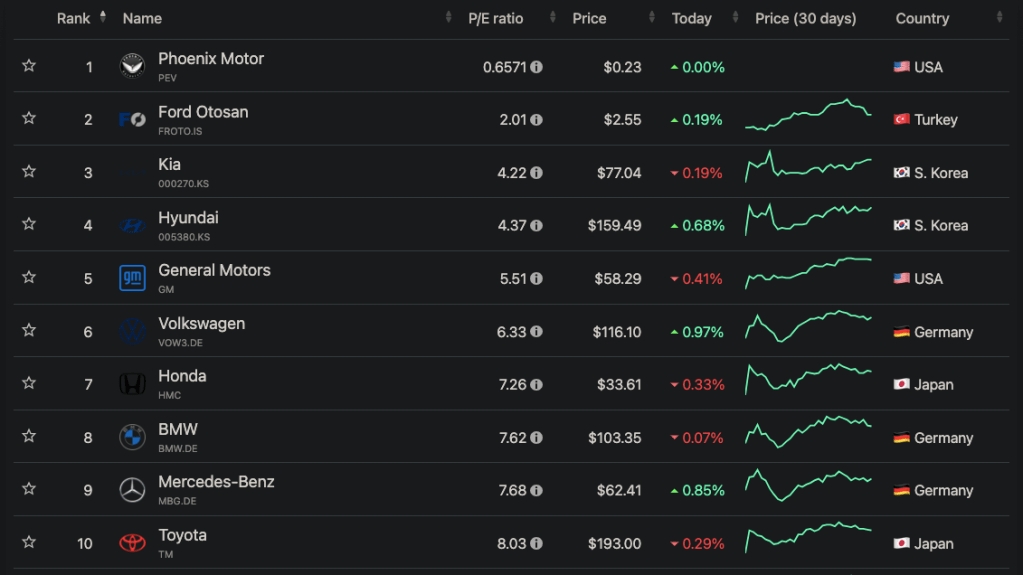
I see Hyundai cars everywhere. But the stock has been left for dead. 4 PE. And it’s not alone…
These days, everyone wants to own the Mag 7. And they don’t want to own much else.
Let’s take a tour of some old economy stocks and see how the markets are treating them.
Autos: Priced for Extinction
It doesn’t get more classically industrial than this. And unless you’re Tesla, in 2025 your car company is worth bupkus.
The long term average PE for the S&P 500 as a whole is 16. But most car makers are trading far below that.
General Motors is trading at a 6 PE. GM has just 1/75th the market cap of NVIDIA, the most valuable company in the world. This despite GM having slightly more revenue!
I’m not saying GM should be worth what NVIDIA is. NVIDIA’s business has much higher margins and more growth potential.
But does a 6 PE make sense?
Just about every other auto stock shares GM’s malaise. Kia is at a 4 PE. VW is at 6. Even Toyota gets just an 8.
The market is pricing auto makers as if they have a few more years to make money before they disappear.
Auto technology is changing, to be sure. But is the picture really that dire?
Mining: The Foundation of Tech
Okay, maybe old school auto makers are a special case. Let’s try another industry. Something totally different.
How about mining?
Surely there are some bright prospects there! Everyone’s talking about how minerals are so important to electronics.
And yet, many major mining stocks are in the toilet.
Take Vale in Brazil. It’s the 14th largest miner in the world by market cap. And it sells at a mere 5 times earnings.
Political risk in Brazil, I know, I know. But then how do you explain Fortescue, a major miner from Australia? It’s selling at just 6 times earnings.
The picture for miners is slightly better than for automakers. But these stocks are still largely ignored.
Communications: The Overlooked Backbone
Let’s move a bit outside industrials. How about telecoms, one of the backbones of a modern economy?
Comcast provides TV and internet across much of America. And if Comcast isn’t in your area, Charter probably is.
Comcast and Charter have tens of millions of customers each. And they sell for PE ratios of 8 and 7 respectively.
The Mag 7 and the S&P 493
For any one of these old school companies, you could find risk factors.
Risk of replacement by Tesla and BYD for Hyundai. Political risk for Vale. Starlink for Comcast.
The stock market is unusually lopsided. Any problems at giants like NVIDIA or Microsoft could send markets plummeting.
At the same time, the S&P 493 have a lot of room to run.
As we’ve seen, many of these stocks are solid, old school companies. And they’re trading at prices well below long term market averages.
Investors have given up on the old school stocks. But for some of us, that could be an opportunity.
Wrap-Up
At some point, the AI fever will break.
“Was it all just a fad? Am I about to lose my shirt?”
Everyone will start selling.
Let them! I’ll be holding steady.
And as I do, those 493 forgotten stocks will function as a stabilizer. John Bogle nailed it:
“Reversion to the mean is the iron rule of financial markets.”
Note: This is NOT investment advice. I have 0 qualifications to advise anyone on their finances and I don’t seek to do so. I’m only offering opinion and a narrative about what I’m doing with my own portfolio. Please do your own research and make your own decisions.
Watch the pitch that Dan Siroker used to raise $12 million. His pitch for Rewind AI (now Limitless) is one of the best I’ve ever seen. Make your deck and pitch like his.
Use YC’s deck template. It’s clear, clean, and simple. There’s a reason YC is the best in the business. You’ll see a lot of similarities to what Dan did — both are clear and concise.
Don’t:
Go above 12 slides. 8-12 will do nicely.
Present more than 1 thought per slide. If you’re pitching Uber, “Taxis suck” could be a single slide.
Use tiny text. Instead, make the text huge. I like 100 pt or higher (seriously). Since you’re sticking to 1 thought per slide, you can go big on font. This makes it easy to flip through, which is what investors do.
Crowd slides with text or graphics. Again, one thought, one slide.
Use fancy designs. Simple and minimal works great. I’m a fan of white text on a black background.
Try to convey everything about your company in a deck. A deck is useful for two things: 1) Helping you get a meeting 2) Guiding you during the meeting. A few brief slides is all you need to accomplish these goals.
Wrap-Up
This post may sound a little harsh. I don’t mean to be a jerk.
I just want you to raise more money!
Happy talk from me won’t get you there. Clear, blunt instruction will.
If you struggle with wordiness, I feel ya! I was an English major…how could I not be wordy?
But I’m determined to improve. And you can improve too.
Make your deck clear and concise. Then, message me and tell me how many millions you raised!
The median Seed stage startup is raising at $20 million pre-money. That’s too high for investors to make a decent return.
High Prices at the Startup Store
AngelList just came out with its wonderful The State of Venture Report H1 2025. It shows that the median Seed valuation is at an eye-watering $20 million pre-money.
Add in a raise of perhaps $4 million, and we’re looking at $24 million post-money. Wow.
One bright spot: at least the valuations didn’t go up. Last year saw the same Seed valuations, although Series A and B did increase this year.
Why Investors Will Struggle to Make Money In This Environment
A portfolio with a median post-money valuation of $24 million will have a very hard time making money. Here’s why…
To make investing in early stage venture worth the risk and illiquidity, you need to hit some serious returns. With the NASDAQ returning 10% a year historically, early stage venture needs to return around 15% in order to be worthwhile.
Over a 10 year fund life, that’s a 4x fund.
In any early stage portfolio, all or nearly all your gains tend to come from a single startup. Let’s say your fund has 35 names in it. To get a 4x fund from one of those 35 startups, you need that one winning startup’s valuation to increase by 140x.
It Gets Worse
But wait…even 140x isn’t enough.
You’ll probably be diluted by 50-60% as the company grows and raises more money. So in reality, you need a 280x return on that top startup in order to get a 4x fund.
So, you’re $24 million post-money Seed stage startup has to hit a valuation of $6.7 billion. And it only has 10 years to do so.
That is incredibly difficult. If the startup is valued at 10x ARR, it would need to hit $670 million ARR. Even if investors give it a rich, 20x revenue multiple, you still need $335 million ARR to hit the target valuation.
No wonder that there are only 295 public tech companies valued at $6.7 billion or higher, according to Companiesmarketcap. In the entire world.
That $6.7 billion is a very rare outcome. We can’t underwrite to that.
What I’m Paying in 2025
My median pre-money valuation so far this year is much lower than the AngelList data. Counting the deal I’m wiring for today, my median pre-money valuation is $13 million. My median post-money is $15 million.
That’s 35% lower than the AngelList median.
Of the 6 deals I’m including, 1 is pre-seed, which slightly throws my numbers off. But suffice it to say, my entry price is significantly lower than most people’s. Another Seed deal I’m planning to do this fall should drive those figures even lower.
At my entry price, I just need a single startup to hit a $4.2 billion valuation. If I can get that, I have a 4x fund even if everything else goes to zero.
And even a $4.2 billion outcome isn’t easy to find! But I like my odds a lot better than if I needed a nearly $7 billion exit.
I’m In a New York State of Mind 🍎
One way I’ve kept prices down: invest at home!
Of my 5 deals so far in 2025, 3 are in the NYC area. The other two are in SF. This is despite SF being a much larger market for startups.
I’m not just investing in New York out of hometown pride. The NYC area is producing incredibly good startups and charging very little to invest in them.
“Please don’t forget us!” I can almost hear NYC founders saying. “We’re making good stuff too.”
And they really are! What’s more, the valuations are roughly half what you’d see in SF.
The market is telling investors to spend less time in SF and more in New York. I’m happy to oblige.
Wrap-Up
We angels aren’t value investors. But we can’t afford to ignore entry price either.
Every now and then, I grab a pricey SF startup or two.
But those expensive deals are exceptions. And if I fill my portfolio with high priced startups with minimal traction, they’re no longer exceptions. They’re the rule.