I fed every deal I’ve ever done to an AI — 38 bets, 400+ pages of deal memos. Here’s what my best investments have in common…
So far, two companies out of my 38 investments have broken out: Micro1 and Rilla. What made these bets so much more successful than others?
This morning, I used NotebookLM to analyze my investment memos describing every deal I’ve ever done. Here’s why the great deals beat the rest.
Massive TAM — My most successful investments addressed huge markets. Take Rilla…Rilla’s sales coaching is valuable for anyone doing outside sales. That’s millions of people.
If you want to build a big company, you need a lot of potential customers. In some of my less successful investments, the TAM was much smaller.
Product Velocity — Successful startups throw a lot of things at the wall and see what sticks. When I invested in Micro1 in 2023, they weren’t doing AI data. They were finding engineers for startups.
But their AI interviewer happened to do an amazing job of finding experts to create data for AI models. Micro1 pivoted to that and has passed $100 million ARR.
When I invested, Micro1’s product velocity was clear. They had popped up a new AI interviewer in no time at all.
Most startups can’t match that pace.
Among my investments that didn’t break out, product velocity was minimal. When competitors released a great new product, they were unable to respond.
Strong Financials — We’re used to startups burning a lot of money. But my most successful investments had little to no burn when I placed the bet.
Compare that to a startup of mine that failed recently. They actually had a small amount of debt when I invested, which should’ve been a red flag.
At the time, I didn’t have the experience to flag that issue. That’s part of the process of investing. Every success and failure teaches you a lesson.
Wrap-Up
NotebookLM did a great job of surfacing the key things my best investments have in common.
This tool is incredibly powerful. It looked at dozens of deal memos and drew conclusions in less than a minute.
In the future, I’m going to back companies in giant markets with strong financials and serious product velocity. If I’m lucky, I’ll nail more companies like Micro1 and Rilla.
Jensen Huang built NVIDIA over 33 years into the world’s most valuable company. Here are 3 of his management secrets you can use today…
1. Flat Org Structure. NVIDIA’s structure is very flat. Jensen has around 60 direct reports. This is probably an order of magnitude more than most CEOs.
This means that Jensen knows everything that happens at NVIDIA. And when someone needs an approval, they don’t have to go through 10 layers to get it.
2. Public Feedback. Most executives take someone aside when they need to give them criticism. Jensen does it in public.
This lets the entire organization learn at once. If Jensen has to correct a subordinate, surely there’s something that the other employees can learn.
Jensen’s approach may seem harsh, but consider that everyone at NVIDIA is a serious professional making a fortune.
3. Long Hours. Simple, but indispensable. Everyone at NVIDIA works long hours, especially Jensen.
60 hours is pretty much the minimum. It goes up to 80 or more when the company is sprinting to release a new product.
The most successful startups I’ve invested in are a lot like NVIDIA. People work six or seven days a week, 12 to 14 hours a day.
There is no substitute for hard work.
Wrap-Up
Jensen may be the greatest entrepreneur alive.
Jensen does not do what the management books say. Instead, he designed Nvidia from a blank sheet of paper.
Try de-layering your organization, giving public feedback and modeling hard work to your employees. No matter how small your company is, using Jensen’s principles gives you a shot at building your own NVIDIA some day!
If you want to learn more from Jensen, check out The NVIDIA Way, a wonderful book on how Jensen created one of the greatest companies of all time.
Inspired by the Besties, here are the 2025 Tremendous Awards…
Biggest Business Winner: The United States. Wherever you look, American businesses are ascendant. A.I. models, GPUs, robotics, space…America ran the table in 2025.
The U.S. has always had an advantage in technology. As technology becomes the only game in town, the U.S. is outpacing the rest.
Biggest Business Loser: Legacy Automakers. In 2025, it became clear that the old school carmakers just aren’t competitive anymore.
Ford took a $20 billion charge on its EV business. None of the legacy companies are anywhere in self-driving. Meanwhile, Chinese automakers are turning out EV’s at unbelievably low prices.
How much longer do these dinosaurs have?
Biggest Political Winner: Zohran Mamdani. Zohran Mamdani beat an incumbent mayor and former governor to become New York City mayor.
I doubt Mamdani will be able to deliver on most of his campaign promises. But for now, he looks like a winner.
Biggest Political Loser: Centrists. The Republican Party has been taken over by MAGA. The Democratic Party is being taken over by socialists.
The big losers are centrist politicians. With less power and a poisonous political environment, many are retiring,
Breakthrough of the Year: Xenotransplantation. In January 2025, physicians at Mass General transplanted a pig kidney into Tim Andrews. He is alive and well.
We already raise tons of pigs for meat. What if we could also harvest an endless supply of organs?
CEO of the Year (Not Named Elon Musk): Jensen Huang. NVIDIA trounced its competitors again in 2025, owning the market for AI chips. The stock soared 39%, adding trillions in market value.
Disgrace of the Year: Somali Daycares. At the very end of 2025, Nick Shirley exposed massive fraud in Somali daycares in Minnesota.
Nick shows us how much of our tax money is wasted by incompetent and perhaps complicit politicians.
And don’t forget, Minnesota is a small state. Can you imagine how much fraud there is in New York and California?
Wrap-Up
In 2025, the leaders in technology pulled away from the rest.
The United States distanced itself from Europe. Tech companies like NVIDIA and Tesla trounced old industries.
At the same time, the political left and right became increasingly extreme. In a time of rapid change, maybe this is inevitable.
I’m both excited and apprehensive to see what 2026 holds.
In homage to the All-In Podcast, here are my predictions for 2026…
Biggest Political Winner — Socialism. Zohran Mamdani recently took control of New York City. This is only the beginning of big wins for socialism in the United States this year.
The party in power usually loses seats in Congress. This year, expect Republicans to lose to far-left Democrats. The cost of living and expiring healthcare subsidies will give fuel to socialists.
Biggest Political Loser — California. California’s proposed wealth tax is driving tons of billionaires out.
Chamath estimates that over $1 trillion in wealth will leave. That money won’t be subject to the wealth tax or any other California tax. These folks also won’t be creating businesses in California.
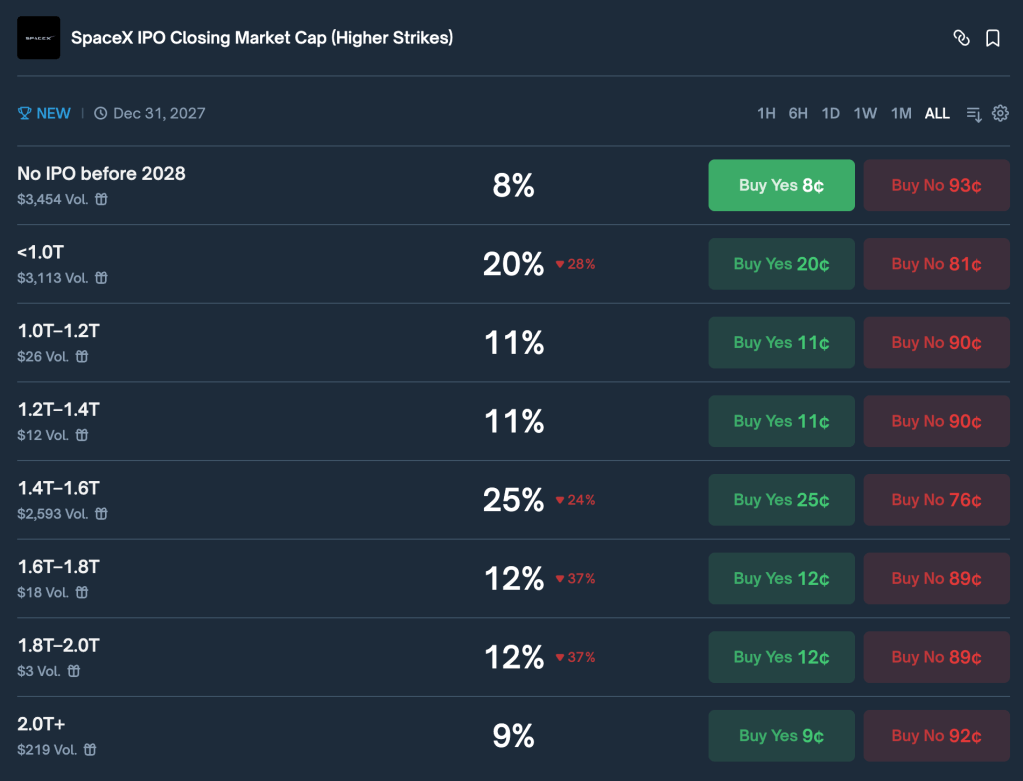
Biggest Business Winner — Elon Musk. SpaceX will likely go public this year, which could make Elon the world’s first trillionaire. Tesla may also release Optimus.
As successful as Elon has been, his best days are ahead.
Biggest Business Loser — Europe. Europe is continuing to fall behind the US and China. Countries like the UK are focused on jailing people for social media posts, not innovation.
Think of all the key new fields… AI models, robotics, self-driving. Europe has little or no presence in any of these areas.
A generation from now, Europe will be where Latin America is today: a pretty but poor continent.
Biggest Business Deal — AI Labs Buy Unique Data. Expect AI labs to buy companies like Reddit and Quora this year.
AI labs are hungry for data. Companies like Reddit and Quora have some of the best.
If an AI lab can lock up a unique data set, it has an advantage over competitors.
Most Contrarian Belief — Biotech Offers Amazing Opportunities. Biotech companies have been in the toilet these last few years. But the growth in AI will present great opportunities in this area in 2026.
AI models can help with drug discovery. AI robotic startups like my investment, Zeon Systems, can automate research.
Put these advancements together, and we could be finding cures much faster.
Best Performing Asset — AI Infrastructure Startups. In order to build AI models, you need high-quality data. The startups providing it will be the best-performing assets in 2026.
Startups like Mercor and my investment, Micro1, are growing more than 10x year over year on millions in revenue. These are some of the highest growth rates ever.
AI labs are spending a fortune on GPUs. To make that investment pay off, they must feed those GPUs with top-quality data.
Worst Performing Asset — Palantir Stock. Don’t get me wrong, Palantir is a great company. But at 100 times revenue, it’s ripe to fall.
The excitement over opportunities with the new Trump administration is likely to cool. This, plus the nonsensical valuation, could set this stock up for a major drawdown.
Most Anticipated Trend — The Triumph of Self-Driving. Waymo is supposed to begin operating in NYC and North Jersey this year. And if you can make it here, you can make it anywhere.
I dreamed about self-driving cars when I was a kid. This year, I hope to ride in one for the first time.
Most Anticipated Media — 90 Day Fiancé. Don’t laugh at me, but I’ve become addicted to this show.
90 Day Fiancé goes deeper with couples than any other show on TV. By the end of a season, you’ve spent over 20 hours with this small group.
I’m looking forward to seeing a new set of couples navigate the struggles of starting a life in America.
Wrap-Up
We have so much to look forward to in 2026. AI will do incredible things in robotics, self-driving, medicine and more.
There’s never been a more exciting time to be alive!
An investor passes on your startup. You can change their mind, right? Wrong.
Here’s why trying to change investors’ minds is a waste of time…
Minds Don’t Change
Investors are interested right away or not at all. When they pass, the chance of you ever getting a dime is minimal.
I’ve invested in 38 companies. Very seldom have I passed on a company and invested later.
Any time you spend trying to change a no to a yes is wasted. You could be finding customers, building product, or pitching other investors.
Find True Believers
True believers will make or break your startup. That’s true with investors, employees, even first customers.
Investors that believe give you money. They also help in a thousand other ways… intros, advice, marketing.
Find people who are excited about your startup. Those are the people who say yes right away.
When you try to change the minds of people who aren’t interested, you’re not attracting true believers.
When to Re-Engage
If an investor passes because you’re too early, ask what stage he invests at. When you hit that stage, contact him.
Last year, I invested in a company that I passed on in 2024. The startup had gone from pre-revenue to several hundred thousand dollars of ARR growing fast.
I messaged the founder begging to invest. Luckily, there was a little space left in their SAFE note!
A “too early” isn’t the same as a “pass.” But make sure you show real progress before you contact the investor again.
Wrap-Up
So many founders try to persuade me after I pass on their startup. It’s not a good use of time.
When investors pass, the solution isn’t to convince them. It’s to pitch more investors.
Fundraising is a numbers game. Pitch enough investors and you can find those true believers.
I’m scouring the world for startups in 3 areas right now. If you’re building here, DM me…
AI Data for Construction — I dream of a world where robots make our houses. Houses will be cheaper and better-built than ever.
But to get there, we need data. Lots of data.
For robots to build a house, they need enormous amounts of video of humans building houses.
So I’m looking for startups that are capturing video from construction sites. The easiest way is probably with Meta Ray-Bans, which are already used by several startups to collect video in other areas.
I recently did an investment in Cortex AI, which captures video from factories. But I don’t know of anyone doing this on construction sites.
Bulk B2B Purchases — Walmart can undercut the corner store because it buys in enormous volume. What if the corner store could do that?
I’m looking for startups that are bundling purchase orders from small businesses. These bundled orders could give small businesses the same great prices as the big boys.
AI Cybersecurity — AI does some wonderful things, but it also presents serious security risks.
Hackers can use an AI browser like Atlas for prompt injection. This lets them take over your system and do whatever they want.
I’m looking for startups building security solutions to counter the threats posed by AI.
There’s a lot of money here. If you can meaningfully improve security, enterprises will give you their grandma.
Wrap-Up
One of the most fun parts of this job is dreaming up new startups. When I come up with a new idea, it’s usually not long until I find a startup doing it.
Helping robots build homes, small businesses compete with the big boys, and companies keep their data safe are three of the best opportunities I can think of.
If you want to start a startup but you’re not sure what to do, try one of these ideas. And when you do, shoot me a message!
Chinese AI startup MiniMax is going public this week at a $7 billion valuation. But its model flopped in my testing.
I ran MiniMax through three tests with real world questions. These are harder to game than benchmarks.
Let me show you where MiniMax does well and where it struggles…
Round #1: Coping With Long Winter Nights
It’s cold and dark most of the time here in North Jersey these days. What are the best ways to prevent Seasonal Affective Disorder?
Minimax has some good ideas, like using a light box. I actually have a drawing tablet, which Andrew Huberman recommended.
But Minimax doesn’t cite any sources. How can I rely on this answer?
I’m giving this round a C.
Round #2: The Top Stocks of 2025
2025 was an incredible year for markets. But I’m curious which stocks did the best.
Can MiniMax help?
Minimax gave me a list that looked great and even provided citations.
But when I clicked the source, it was completely wrong. Minimax was looking at the best performing stocks of 2024.
This is a common problem even among good AI models. They don’t know what day it is!
I don’t understand why this happens. It seems like an easy thing to fix.
I’m giving this round an F.
Round #3: Handicapping the 2028 Election
We’re seeing a lot of dissent in the Republican Party these days.
Secretary of State Marco Rubio is raising his profile by handling Venezuela. Meanwhile, former Congresswoman Marjorie Taylor Greene has attacked Trump for intervening overseas.
With these different factions forming, who will get the nomination in 2028?
Let’s ask Minimax…
Vance is the clear frontrunner. MiniMax likes Rubio for vice president.
Minimax made an interesting point: if one of them failed to get the presidential nomination, the other would likely get vice president. It could wind up Rubio-Vance, not just Vance-Rubio.
Minimax cited quality sources, including The Hill. With original thinking and good sourcing, I’m giving this response an A!
Wrap-Up
MiniMax earned a C overall in my testing.
Its responses are inconsistent. One will be excellent, the next useless.
If you’re relying on these outputs to power your application, Minimax just isn’t reliable enough. If you want something open source, Kimi or DeepSeek are better choices.
China is about to launch its first AI model IPO, Zhipu AI. Investors may be excited, but Zhipu’s product is weak.
China’s first IPO of an LLM startup, Zhipu AI, will start trading Thursday. The IPO is expected to value Zhipu at nearly USD $7 billion.
This morning, I ran it through a series of tests. I found Zhipu to be well behind top American models.
Let me show you where Zhipu falls short…
Round #1: Learning About AI Chips
NVIDIA and AMD introduced new AI chips at CES this week. How do these chips differ?
Zhipu gave a strong answer, emphasizing NVIDIA’s better software.
But I would have liked to see Zhipu cite better sources. It mostly cited Substacks and Yahoo Finance articles rather than technical specs.
I’m going to give this round a B+.
Round #2: Zhipu the Personal Trainer
I’ve done strength training twice a week for years. Every quarter, I do a deload week to give myself some rest.
But is that enough?
Zhipu recommends taking a deload week every 6-8 weeks instead. But it doesn’t cite any sources.
How can I rely on this answer?
When I run the same query through Grok, it answers faster and cites 25 sources. That’s the bar for an AI model today.
I’m giving this round a C.
Round #3: Zhipu the Sleep Coach
I just got back from a wonderful trip to Wisconsin. I saw friends and family over the holidays, which made me really happy.
There was only one downside: my sleep. The system I have dialed in at home just isn’t the same on the road.
Let’s ask Zhipu how to get my sleep back on track…
Zhipu gives some interesting ideas, like getting light in the morning. But the sources it cited were all in Chinese.
Zhipu is supposed to be bilingual in English and Chinese, so citing sources in the wrong language is a serious problem.
I’m going to give this round a C as well.
Wrap-Up
Overall, Zhipu earns a C+ in my testing.
Its answers are decent, but sourcing is weak. It’s hard to tell if Zhipu’s answers are correct or not.
These responses would have been excellent two years ago. But today, Grok and Gemini blow Zhipu out of the water. Zhipu is also behind Chinese models like Kimi and DeepSeek.
I had fun playing with Zhipu, but I won’t be using it again any time soon. It’s just too far behind.
This is the definitive biography of Michael Jordan. I’ve read several other books on MJ, but none digs as deep.
I loved playing basketball as a kid, but I wasn’t that good. Still, I looked up to Michael Jordan.
If you want to excel in anything, Jordan will give you the blueprint.
The Rest of the List…
For the remainder of the list, I grouped books by theme.
If you have a strong interest in investing, biotech or fiction, feel free to jump to those sections!
Business and Investing
Hetty — Hetty Green was one of the most important investors at the turn of the last century. Called the “Witch of Wall Street,” she worked alone and amassed a fortune worth billions in today’s money.
Gambling Man — How Masayoshi Son came from obscurity to be the richest man in the world, lost a fortune, and made it back.
The New Tao of Warren Buffett — “Cryptocurrencies are like rat poison squared.” That quote alone was worth the price of admission!
Damn Right! — This biography of Charlie Munger gives great advice, like the importance of avoiding self-pity.
Warren Buffett Speaks — “… we like great companies with dominant positions, whose franchise is hard to duplicate, and has tremendous staying power or some permanence to it.“ This series of quotes from Buffett break down his investment philosophy.
Memos from the Chairman — Ace Greenberg was the chairman of Bear Stearns in its heyday. If they had stuck to his simple advice of serving the customer and being frugal, they’d still be around today.
Common Stocks and Uncommon Profits — This slim volume from 1958 is one of Buffett’s top book recs. Much of his approach of investing in high-quality companies at reasonable prices comes from this book.
eBoys — How Benchmark hit eBay and became one of the top firms in Silicon Valley.
Talent — Tyler Cowen and Daniel Gross explain how to spot top talent.
Grinding It Out — Ray Kroc’s account of building McDonald’s.
The Default Line — Go behind the scenes as the EU deals with the fallout from the financial crisis. I ordered this book from England years ago. Since then, I’ve read it three times, often near market peaks.
The Courage to Act — Ben Bernanke’s account of steering the Fed through the financial crisis.
Boomerang — Michael Lewis tours the crisis-struck West in the wake of the financial crisis.
Population Plunge Meets AI Revolution
One Billion Americans — Matthew Yglesias explains that for the United States to stay number one, we have to grow our population big time.
Empty Planet — Exploring the fertility crisis from Korea and Japan to the developing world.
Homegrown — The story of Oklahoma City bomber Timothy McVeigh. One surprising fact: had the GM plant in his hometown not closed, he might have become a normal factory worker like his father and grandfather.
Janesville — When Janesville, Wisconsin’s GM plant closed, the town never truly recovered. AI is going to cause a lot more Janesvilles.
Industrial Society and Its Future — The manifesto of the Unabomber. I find most of what Kaczynski says to be off base, but it does get me out of the techno-optimist echo chamber.
Breakneck — Dan Wang explains that although China is catching up to the West, its future is bleak.
Politics
Original Sin — How Joe Biden and the Democrats lost the presidency.
I was laying on the couch, eyemask on, earplugs in, trying to imagine the next great startup. “What about collecting data from factories to train robots?” Well, I found it…
Cortex AI gathers video from factories and workshops. It sells that data to robotics companies to help train robots.
To teach robots to work in factories, we’re going to need tons of video. But there isn’t much video available from real facilities.
Robotics companies are forced to use data from labs and simulations. That data isn’t realistic.
Several startups collect video from inside people’s homes to feed to AI models. Cortex’s approach is different — they are focused on industrial data.
Getting Real World Data
Cortex AI is building the marketplace for industrial robotics data.
Factories and workshops make money by providing video. In businesses with tight margins, this additional revenue stream is huge!
Robotics companies love this data because it’s from the real world. This lets their robots learn faster.
The Perfect Founder
The founder, Lucas Ngoo, has one of the most impressive backgrounds of anyone I’ve invested in.
Lucas was the co-founder and CTO of Carousell, a marketplace for used goods in Southeast Asia. Carousell was backed by Sequoia India and is valued at $1.1 billion.
Lucas’s background is perfect because he’s already built a super successful marketplace.
Carousell is in a very different market — used goods vs. AI data. But a marketplace is a marketplace, and Lucas has seen this movie before.
What About Jobs?
Robots will replace some humans in factories. This is inevitable.
Imagine if we had refused to adopt tractors because they would replace farm workers. Almost everyone would still be doing backbreaking labor on farms for very little money.
Technological progress has some cost in the short run. But in the long run, we are way better off.
Wrap-Up
I’m delighted to have a little slice of Cortex AI’s recent seed round!
It’s rare that I see a fantastic founder building in just the right market. When I do, I’m itching to place a bet.
This investment showed me the value of daydreaming.
I learned this technique from studying Cyan Banister and James Simons, two top investors. They’re both known for spending hours just thinking.
I spent hours imagining big opportunities. When I saw Cortex AI, I knew I’d found what I was looking for.
If I hadn’t prepared my mind by daydreaming, I might have missed it!
If you work in robotics, check out Cortex AI’s data and take your system to the next level. And if you run a factory, look into selling your data!
This is the last post of the year. I’ll see you guys on Monday, January 5th.