Tremendous

An angel investor's take on life and business

  • Most startups will never be a huge success. Their vision isn’t big enough.

    Let’s take a look at 3 of the most successful startups of the 2020’s. All have reached valuations of over $10 billion.

    Each of these founders imagined a radically different world, then went out and made it happen.

    Colossal Biosciences — $10.2 billion. Yesterday, I was listening to an interview with the founder, Ben Lamm, on the Joe Rogan podcast. Listen to Ben for 10 minutes and you’ll see how ambitious he is.

    Ben plans to bring back the woolly mammoth and other extinct species. If he realizes his vision, the world will be full of animals none of us have ever seen.

    Already, they’ve created the woolly mouse and resurrected the dire wolf. And the company is just 3 years old.

    Do you see how different this is from the typical startup? A typical startup tries to help you find sales leads a little more easily, something like that. Incremental change.

    Ben doesn’t care about incremental change. His vision is radical.

    Figure — $39.5 billion. Figure is developing humanoid robots. Founder Brett Adcock plans to make one for every human being in existence.

    This is a radically different world. Robots would be doing manufacturing, farm work, even cleaning our houses.

    Compare this to a typical startup. Maybe that startup is making meeting notes easier or scheduling a little smoother.

    That just doesn’t change things the way Figure could. So it simply cannot grow as large.

    Cursor — $10 billion. The other two startups on this list are deep tech. But pure software can be transformative too. Cursor is a great example.

    Cursor lets anyone create software, no coding background needed. If you had an idea for a software tool in the past, you had to find a coder to build it for you.

    Now, everyone is free to build their own tools that are perfect for them. Imagine the 1,000 businesses that could enable.

    Cursor is a powerful, general purpose tool. Software startups like that can become massive.

    Wrap-Up

    I had a chance to invest in Figure’s seed round in March of 2023. I passed on it, concerned about the valuation and how capital intensive the business would be.

    That turned out to be a huge mistake. I’d be sitting on a 100x return in only 2 years if I’d had the brains to put a check into it.

    Since then, I’ve been thinking about how to catch the next Figure. My conclusion: I need to look for giant opportunities.

    When a company’s ambitions are small, even the best case scenario isn’t that great.

    Startups with a giant vision usually bite the dust too. But at least I have a chance of a big success.

    And one is all it takes.

    More on tech:

    Five Things Founders Should Never Pay For

    Meet My Latest Investment: Sent.dm

    How to Build a Relationship with Investors

    Save Money on Stuff I Use:

    Fundrise

    This platform lets me diversify my real estate investments so I’m not too exposed to any one market. I’ve invested since 2018 with great returns.

    More on Fundrise in this post.

    If you decide to invest in Fundrise, you can use this link to get $100 in free bonus shares!

    Misfits Market

    I’ve used Misfits for years, and it never disappoints! Every fruit and vegetable is organic, super fresh, and packed with flavor!

    I wrote a detailed review of Misfits here.

    Use this link to sign up and you’ll save $15 on your first order. 

  • There’s an AI model that’s 13x faster than ChatGPT. The cost: $0. But can Mistral’s Le Chat beat the best tools from the US?

    This morning, I put the French model through its paces. I asked it 3 questions I actually need the answer to. I posed these same 3 questions to Grok 3 on the blog recently, and it produced the best responses I’ve seen.

    Can Mistral’s Le Chat do better? Let’s find out…

    1) Le Stock Analyst. I recently had Grok help me with my index fund allocation. But maybe Mistral can give me some even better ideas.

    Here’s the prompt I used:

    “Assume I have a portfolio of index funds. My goal with this portfolio is long term growth. How should I allocate this portfolio across different types of index funds? Consider options like US index funds, foreign stock index funds, etc. I am 39 years old, so my time horizon is long. My risk tolerance is high. What would be the best allocation, given all this information? Use the best research you can find to support your answer.”

    Let’s see what Mistral advises:

    Mistral gave a thorough and well reasoned response. It advises a split between US and foreign index funds with a small allocation to bonds.

    However, Mistral doesn’t consider a 100% stock portfolio, which can make sense for a younger person with a high risk tolerance. And while it cites relevant sources, there are only 6. Grok searched over 40 different sites.

    Mistral’s answer was better than what I’ve seen from Gemini, Claude or Alibaba’s Qwen. But Grok 3 takes this round.

    2) Le Startups. With fertility rates on the decline, I’m looking for startups that make it easier for women to have children later in life.

    Let’s see if Mistral can help. Here’s my prompt:

    “What are the most interesting startups at pre-seed stage working on solutions to increase fertility? Consider startups to lower costs and improve effectiveness of IVF, and also startups to improve egg health for older women, among other possible ways to boost fertility. Please only show me startups that have raised $750,000 or less in funding.”

    Here’s what Mistral found:

    Mistral found some good candidates, like Gameet, and others that were too late stage. Grok produced a similar response, finding some good candidates and others that were outside my search criteria.

    I’ll call this round a tie.

    3) Le Meetings. I’ve got a meeting with an interesting AI tutoring startup set for this afternoon. So how do I get the most out of my time with the founder?

    Here’s the prompt I used:

    “As an angel investor, I meet with a lot of startup founders. I want to do the best job I can in those meetings. What are some tips to perform better, be more helpful, and learn more about the startups I meet with?”
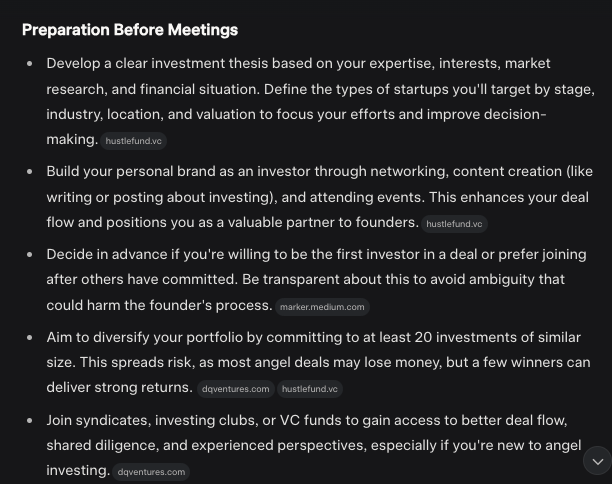
    Let’s see what Mistral advises:

    Mistral gives some great advice here. It reminds me to be empathetic to the difficult job these founders are doing. It also emphasizes how important it is to be transparent about my decision, whether it’s a yes or a no.

    When I posed this question to Grok, it told me to watch the founder’s body language. That was an especially useful tip that Mistral didn’t include.

    This round is close, but I have to give it to Grok.

    Wrap-Up

    Mistral’s Le Chat is a very impressive model. For answering general questions, it’s better than Gemini, Claude, or Alibaba’s Qwen.

    But Grok 3 is still the best model I’ve used. It scours the internet for information, analyzes it intelligently, and presents it in seconds. Le Chat just can’t compete.

    It’s amazing that a little French startup is beating giants like Google and Alibaba. But Mistral has a way to go before they take the #1 spot.

    More on tech:

    How Good is Grok 3?

    Testing Google’s New Gemini 2.5 Pro Model

    Testing Alibaba’s New Qwen Model

    Save Money on Stuff I Use:

    Fundrise

    This platform lets me diversify my real estate investments so I’m not too exposed to any one market. I’ve invested since 2018 with great returns.

    More on Fundrise in this post.

    If you decide to invest in Fundrise, you can use this link to get $100 in free bonus shares!

    Misfits Market

    I’ve used Misfits for years, and it never disappoints! Every fruit and vegetable is organic, super fresh, and packed with flavor!

    I wrote a detailed review of Misfits here.

    Use this link to sign up and you’ll save $15 on your first order. 
  • Some of the greatest companies in the history of capitalism are selling at ridiculously low prices right now.

    How would you like to have Warren Buffett as your personal money manager? Today, he’s available at a discount: just 12 times earnings. And Berkshire isn’t the only blue chip that’s on sale.

    Stocks in the Bargain Bin

    Trump’s big tariff announcement Wednesday has spooked markets. The S&P 500 is down 10% and markets worldwide are falling in sync.

    This is leading to some incredible bargains in stocks.

    Let’s take a look at 5 of the best companies in history. Here are their current price/earnings multiples:

    Google: 19
    Berkshire Hathaway: 12
    Merck: 12
    Bank of America: 11
    Samsung: 11

    Google is the greatest money machine ever invented by man. You could easily justify a 25 PE on that.

    As for Berkshire and Merck, these are tried and true companies, the bluest of blue chips. They could jump by 50% and still not be overvalued.

    This is how tough markets end. You begin to see some ridiculous bargains like these. Then, a few folks tiptoe into the market and scoop them up.

    Is the Whole Market Cheap?

    Despite the drop since Trump’s tariff announcement, stocks on the whole are not especially cheap. The S&P PE ratio sits at 25, still above the historical average of 15-20 times earnings.

    The market is dominated by the Magnificent 7 stocks, many of which are still trading at rich multiples:

    Tesla: 113
    Nvidia: 32
    Amazon: 31
    Microsoft: 29
    Apple: 29

    These stocks have come down, but their prices were so high at the market peak that they’re still expensive. Less fashionable companies, however, are trading at very low valuations.

    But What About Tariffs?

    Even if the tariffs stay on, the valuations of some stocks are incredibly low. But what if they’re only temporary?

    The White House is already beginning negotiations with dozens of countries on lowering tariffs. If our trading partners cut their rates, Trump may cut ours, perhaps all the way down to zero.

    Relief on the tariff front would be a massive tailwind for the market.

    And don’t forget about tax cuts. Congress is working on a major package as we speak. Lower taxes could give markets a significant boost.

    Wrap-Up

    Investors are manic depressive.

    When they’re excited, they bid stock prices too high. When they’re scared, they panic sell and prices fall through the floor.

    We’re seeing amazing bargains right now in some of the best companies of all time. I expect buyers to pop up for those companies, supporting the market.

    As for me, I’m holding all my positions.

    Tariffs or no tariffs, companies will continue to innovate. I intend to own a piece of it.

    More on markets:

    As Tariffs Hit, Lower Interest Rates Could Cushion the Blow

    Using Grok 3 to Manage My Stock Portfolio

    Buffett’s Annual Letter

    Save Money on Stuff I Use:

    Fundrise

    This platform lets me diversify my real estate investments so I’m not too exposed to any one market. I’ve invested since 2018 with great returns.

    More on Fundrise in this post.

    If you decide to invest in Fundrise, you can use this link to get $100 in free bonus shares!

    Misfits Market

    I’ve used Misfits for years, and it never disappoints! Every fruit and vegetable is organic, super fresh, and packed with flavor!

    I wrote a detailed review of Misfits here.

    Use this link to sign up and you’ll save $15 on your first order. 

  • Google recently dropped its most advanced model yet, 2.5 Pro. This morning, I put it through 3 real world tests to see if Google can beat the best model I’ve used so far: Grok 3.

    I asked it 3 questions I actually need the answer to. These are the same questions I posed to Grok 3 recently.

    Let’s get started!

    1) Optimize My Stock Portfolio. I recently had Grok help me fine tune my index fund portfolio. But maybe Gemini can do better.

    Here’s the prompt:

    “Assume I have a portfolio of index funds. My goal with this portfolio is long term growth. How should I allocate this portfolio across different types of index funds? Consider options like US index funds, foreign stock index funds, etc. I am 39 years old, so my time horizon is long. My risk tolerance is high. What would be the best allocation, given all this information? Use the best research you can find to support your answer.”

    Let’s see what Gemini says:

    Gemini’s response was smart and well-reasoned. Like Grok, it recommends a portfolio of 90-100% stocks with a split between domestic and foreign.

    But there was one big problem with Gemini’s answer: it had no sources.

    Gemini mentioned that Modern Portfolio Theory supports its answer. But there’s no link to any research and no way to verify its claim.

    Grok 3, by contrast, cited over 40 high quality sources. I’m giving this round to Grok.

    2) Find Me Some Startups. I’m really interested in startups that could help us with our baby bust in America. So, I set Gemini to work on it.

    Here’s the prompt I used:

    “What are the most interesting startups at pre-seed stage working on solutions to increase fertility? Consider startups to lower costs and improve effectiveness of IVF, and also startups to improve egg health for older women, among other possible ways to boost fertility. Please only show me startups that have raised $750,000 or less in funding.”

    Here’s what Gemini came up with:

    Gemini’s answer was useless. It gave me a startup, Gameto, that has raised $73 million in funding. This is a clear violation of the instructions I gave. Similarly, Alife has raised over $30 million.

    Then, it gave me some general ideas of types of startups to look at. This isn’t useful either — I asked for specific companies.

    Grok, on the other hand, gave me some actual early stage startups to research. Once again, the round goes to Grok.

    3) Making My Meetings Better. Finally, I asked Gemini to help me with a problem I struggle with daily: how to do my best when I meet with founders.

    I want to be present and helpful. I want to ask good questions and learn a lot about the founder’s vision.

    Here’s the prompt I used:

    “As an angel investor, I meet with a lot of startup founders. I want to do the best job I can in those meetings. What are some tips to perform better, be more helpful, and learn more about the startups I meet with?”

    Let’s see what Gemini advises…

    Gemini’s advice is spot on. It tells me to be sure I’m on time and to offer constructive feedback when I pass on a company. Those are things I already try to do, but it’s good to have that emphasized.

    Gemini’s answer was just as good as Grok’s here. So, I’ll call this round a tie.

    Wrap-Up

    Grok 3 beat Gemini 2.5 handily, winning 2 out of 3 rounds.

    If Google wants to dethrone the leaders like Grok and ChatGPT, they’re going to have to do better than this. I expect more out of a $2 trillion company.

    This model is actually worse than their existing Deep Research model, which gives precise and well sourced responses. With Gemini 2.5, Google is actually going backwards.

    If you need answers to your questions or want to build AI into your product, Gemini isn’t it. Grok 3 is a better choice.

    Have a great weekend everybody!

    More on tech:

    How Good is Grok 3?

    Testing Alibaba’s New Qwen Model

    DeepSeek vs. Gemini Deep Research: Which Model Is King?

    Save Money on Stuff I Use:

    Fundrise

    This platform lets me diversify my real estate investments so I’m not too exposed to any one market. I’ve invested since 2018 with great returns.

    More on Fundrise in this post.

    If you decide to invest in Fundrise, you can use this link to get $100 in free bonus shares!

    Misfits Market

    I’ve used Misfits for years, and it never disappoints! Every fruit and vegetable is organic, super fresh, and packed with flavor!

    I wrote a detailed review of Misfits here.

    Use this link to sign up and you’ll save $15 on your first order. 

  • Trump’s new tariffs are making headlines. But a less noticed trend could be a lot more important: a recent fall in interest rates.

    Tariffs raise the cost of imported goods. Interest rates determine what we pay to borrow for a home, auto, or credit card loan.

    For most startups, the positive effect of lower interest rates will matter more than the negative impact of tariffs.

    A Broad Fall in Interest Rates

    The 10 year Treasury bond rate has fallen from a recent high of 4.79% in mid-January to 4.17% today. This rate serves as the benchmark for mortgages.

    Other rates are down as well. The prime rate is down from 8% to 7.5% in the last few months. The 5 year Treasury rate has fallen around 70 basis points. These rates drive the cost of auto and credit card loans.

    Rates Matter More Than Tariffs For Most Startups

    Tariffs will have little effect on most software startups. They don’t import anything to make their product. But lower rates will help many companies.

    For prop tech startups, lower rates are a godsend. The 10 year Treasury is so important to this market that a CRE broker friend of mine checks it every day. Those lower mortgage rates make people much more likely to buy a house.

    Similarly, lower rates for car loans help startups in the auto sales sector. And a lower prime rate should be great for fintech startups generally.

    Even for hardware startups, the impact of tariffs should be limited.

    Most make their product here in America. Their main concern will be an increase in the cost of some components, which may be sourced abroad.

    Wrap-Up

    My hope is that Trump uses these tariffs as a negotiating tool to get us better terms of trade with other countries. If tariffs help us sell more to the rest of the world in the long term, they could be a net positive.

    But if the tariffs stay on for too long, they could be a drag on economic growth. We should use tariffs as a tool, not an end in themselves.

    More on markets:

    Is the Consumer in Trouble?

    Using Grok 3 to Manage My Stock Portfolio

    Buffett’s Annual Letter

    Save Money on Stuff I Use:

    Fundrise

    This platform lets me diversify my real estate investments so I’m not too exposed to any one market. I’ve invested since 2018 with great returns.

    More on Fundrise in this post.

    If you decide to invest in Fundrise, you can use this link to get $100 in free bonus shares!

    Misfits Market

    I’ve used Misfits for years, and it never disappoints! Every fruit and vegetable is organic, super fresh, and packed with flavor!

    I wrote a detailed review of Misfits here.

    Use this link to sign up and you’ll save $15 on your first order. 

  • The last two checks I wrote were into companies I met a year ago. This is why building relationships over time is so important if you want to raise money.

    “Investors invest in lines, not dots.”

    Mark Suster

    My Portfolio Behind the Scenes

    Let’s take a look at those two recent investments…

    When I first met each founder, the companies were just getting started. Both founders really impressed me as hardworking and intelligent.

    But since the companies were brand new, I wasn’t ready to write a check yet.

    They both kept in touch, sending me their investor updates and occasionally pinging me with some special news. I’d hit them up every few months as well, curious to hear the latest.

    Fast forward a year. Both companies had grown enormously.

    It was time to place some bets!

    What To Do When You’re “Too Early”

    When you meet with an investor, he’ll often give you a “too early” or a “not yet.”

    That’s not the end of the world! That just means you’ve started a new relationship. That may not get you a check now, but it could in a few months or a year.

    Note down what stage that investor focuses on. If you’re doing $40k ARR and he invests at $1 million, write that down in your investor spreadsheet.

    Then, contact him when you hit $1 million.

    He’ll already know who you are. He’ll also respect your persistence in getting all the way to that milestone!

    It’s easier to get a check from someone you’ve already met than send another cold message.

    Putting Fundraising on Autopilot

    Some founders add prospective investors to their investor update. Daniel at Sent did this after we met last year.

    Last month, I got an update from Sent. Their revenue was exploding. We’re talking the type of growth I rarely see among the thousands of startups I look at.

    It was time to get in.

    So I sent Daniel a message asking if there was any space left in their current round. Luckily, there was a small sliver left, which I quickly grabbed.

    If you send your investor updates to prospective investors like Daniel did, your fundraising will be on autopilot.

    When VC’s see you growing like crazy, they’ll be asking you to invest. You won’t need to ask them.

    All you’ll have to do is focus on growing your business.

    Wrap-Up

    When an investor tells you no, it’s easy to get discouraged. Instead, you should view that as a beginning, not an end.

    You’ve met someone new and started a relationship. Now may not be the ideal time to work together. But that time may come soon.

    Get a firm idea of what they’re looking for. When you hit that level, try them again.

    This time, they might be begging you to invest.

    More on tech:

    Five Things Founders Should Never Pay For

    Meet My Latest Investment: Sent.dm

    Three Green Flags I Look For in Founders

    Save Money on Stuff I Use:

    Fundrise

    This platform lets me diversify my real estate investments so I’m not too exposed to any one market. I’ve invested since 2018 with great returns.

    More on Fundrise in this post.

    If you decide to invest in Fundrise, you can use this link to get $100 in free bonus shares!

    Misfits Market

    I’ve used Misfits for years, and it never disappoints! Every fruit and vegetable is organic, super fresh, and packed with flavor!

    I wrote a detailed review of Misfits here.

    Use this link to sign up and you’ll save $15 on your first order. 

  • Taichi Ohno invented modern, just-in-time manufacturing at Toyota. Near the end of his career, Ohno gave up his entire playbook in one slim volume, The Toyota Production System.

    So when I found an antiquated looking copy in a Little Free Library near my home, I had to give it a read.

    Whether or not you’re in manufacturing, Ohno’s lessons can help your business perform at a higher level.

    Waste is the Enemy

    “The basis of the Toyota Production System is the absolute elimination of waste.” – Taichi Ohno

    For generations, manufacturing had worked the same way. Create parts, assemble them into finished goods, sell the goods.

    How else can you do it, right?

    But as an engineer at Toyota, Ohno couldn’t afford to buy huge numbers of parts he might not use. The Japanese market was small and people couldn’t afford to buy as many cars as Americans could.

    For Toyota to keep its head above water, it had to eliminate waste. So instead of pushing parts through the assembly line, Ohno did it backwards.

    Once Toyota had an order for a car, each station would ask the station before it for parts. This made sure that Toyota only created the parts it would actually use.

    They called it “just-in-time.”

    At the time, it was a fringe idea. Today, factories all over the world use Ohno’s system.

    Staying Close to the Product

    “Stand on the production floor all day and watch — you will eventually discover what has to be done.” – Taichi Ohno

    Ohno wasn’t some MBA recruited into a management training program. He started out on the shop floor and even as a top executive, he spent much of his time there.

    The best founders today operate just like Ohno. Elon Musk spends lots of time on the factory floor at Tesla and SpaceX, even sleeping there during busy periods.

    Sticking close to the product is critical outside manufacturing as well. Brian Chesky obsesses over every screen of the Airbnb app, even though he has countless engineers working for him.

    Listen to Employees

    People often think assembly line employees just turn the same screw all day. Not at Toyota, they don’t.

    Every single employee has the authority to stop the production line. They use an “andon cord,” a cord they pull that stops the line when a problem arises.

    At Toyota, everyone is responsible for quality, not just top managers.

    Ohno didn’t just trust employees to spot defects. He also relied on them for new ideas on how to improve Toyota’s manufacturing process.

    In any business, the frontline employee knows more about what’s happening at the company than anyone else does.

    Good managers listen to them. Rotten managers dismiss them, certain they know better.

    Wrap-Up

    You’re probably not making cars like Ohno. But those of us in tech have a lot to learn from Toyota.

    We love to pile on the perks. Ohno, on the other hand, was laser focused on eliminating waste.

    We burn a lot of time in meetings. Ohno spent his time on the factory floor.

    We bury ourselves in layers of management — Ohno preferred to learn from the workers on the line.

    Ohno stayed focused because he was devoted to the mission: making a great car and advancing Japanese industry. How many of our companies in tech have such a clear purpose?

    I can think of a few: Tesla, SpaceX, Anduril. And they’re some of the most successful companies in the world.

    Drop Taichi Ohno into any of them today, and I think he’d feel at home.

    More on tech:

    Three Green Flags I Look For in Founders

    Tesla Model Y: A Case Study in Product Design

    Your First Cybercab Ride

    Save Money on Stuff I Use:

    Fundrise

    This platform lets me diversify my real estate investments so I’m not too exposed to any one market. I’ve invested since 2018 with great returns.

    More on Fundrise in this post.

    If you decide to invest in Fundrise, you can use this link to get $100 in free bonus shares!

    Misfits Market

    I’ve used Misfits for years, and it never disappoints! Every fruit and vegetable is organic, super fresh, and packed with flavor!

    I wrote a detailed review of Misfits here.

    Use this link to sign up and you’ll save $15 on your first order. 
  • “If a commercial company operated the way the federal government does, then it would immediately go bankrupt, it would be delisted, the officers would be arrested.”

    Elon Musk

    America is $36.2 trillion in debt. We’re adding another trillion every few months. At this rate, we are headed for national bankruptcy.

    So of all the things the new Trump Administration is doing, DOGE may be the most important. In an interview with Bret Baier on Fox News, Elon and his team share the incredible progress they’ve made so far.

    Slashing Waste

    DOGE is cutting $4 billion a day on average, seven days a week. Elon’s goal is to cut the federal deficit by half, or $1 trillion.

    The wasteful spending DOGE is finding boggles the mind. $2 billion went to a brand new nonprofit founded by Stacey Abrams. $10 million went out the door to promote “gender equality in the Mexican workplace.”

    Do you care about gender equality in the Mexican workplace? Yeah, me neither.

    Whenever anyone points out this waste, the Beltway types say “That’s just a small percentage of federal spending!”

    Perfectly true. But if you add up all these instances of waste and fraud, we’re talking about a huge amount of money.

    The Cost of Living Beyond Our Means

    When we spend money we don’t have, we must borrow to make up the difference. A lot of that borrowed money comes from China.

    With every cent we spend, we have to ask ourselves “Is this worth borrowing money from China to do it?”

    Heavy borrowing also crowds out private investment. The $2 trillion we need to finance the deficit every year could’ve gone somewhere else.

    How about building homes to help with the housing crisis? That would measurably improve the lives of Americans. But instead, the money went to foreign countries and tricky nonprofits.

    Should DOGE Be Permanent?

    Fixing the federal budget is incredibly difficult. But every problem comes down to people, and Elon has the best people in the world on it.

    When I listen to Airbnb co-founder Joe Gebbia and former rocket scientist Steve Davis tell us how they’re going to fix government, I want to believe. Surely, the efforts of all these brilliant people won’t come to nothing.

    There’s only one change I’d make to DOGE: make it permanent.

    Right now, DOGE is scheduled to close on July 4, 2026. That gives the Washington blob every incentive to wait them out.

    If DOGE were permanent, the Washington establishment would understand that there is nowhere to hide. You can’t tie Elon up in lawsuits for a year and then get back to feeding at the government teat.

    Wrap-Up

    How will Elon overcome the lawsuits that try to stop his work? And will DOGE become permanent?

    Just 71 days into the new administration, we can’t expect to have an answer to all these questions.

    But in just a couple of months, DOGE has made incredible progress. However formidable the opposition, I’m certain of one thing: Elon and his men will outwork them.

    More from the blog:

    How DOGE Can Destroy All Opposition

    Elon Musk (Part 1): Overcoming the Odds

    Tesla Model Y: A Case Study in Product Design

    Save Money on Stuff I Use:

    Fundrise

    This platform lets me diversify my real estate investments so I’m not too exposed to any one market. I’ve invested since 2018 with great returns.

    More on Fundrise in this post.

    If you decide to invest in Fundrise, you can use this link to get $100 in free bonus shares!

    Misfits Market

    I’ve used Misfits for years, and it never disappoints! Every fruit and vegetable is organic, super fresh, and packed with flavor!

    I wrote a detailed review of Misfits here.

    Use this link to sign up and you’ll save $15 on your first order. 

  • Here’s how I know I met a great founder: he’s at a customer site when we talk, sitting next to the Pepsi machine. Too often, investors look for the wrong things when they meet a founder. Did he go to Harvard? Is he in San Francisco? Is a big name investing?

    These things don’t matter. Here are 3 green flags I look for instead:

    1) At a Customer Site. Let’s go back to the man by the Pepsi machine.

    That fellow was Zach Barney, founder of Mobly.

    Zach was carving out time to meet with me in between customer visits. He was clearly focused on his customers, going to their offices in person even though it was almost Christmas.

    Any founder this customer obsessed is bound to win.

    I invested in Mobly shortly after our meeting. And sure enough, Mobly has grown like crazy since then. In fact, I doubled down recently.

    2) Goes to Customer Conferences. Whenever I see a founder gripping and grinning with Mark Cuban at SXSW, I cringe. But when I see a founder who sells SaaS for the trades at a conference of plumbers, I reach for my wallet.

    The great founders go where their customers are. Sometimes, that’s their office, like Zach did above. Other times, that’s an industry conference.

    For most founders, these boring conferences filled with boring customers are a much better use of time than SXSW or TechCrunch Disrupt. Here’s a rule of thumb: if it’s cool, it’s probably a waste of time.

    3) Transparent. The great founders give clear answers to questions.

    Me: “Where is ARR right now?”

    Them: “We’re at $485k ARR as of this morning.”

    See how easy that was? No obfuscation.

    These amazing founders don’t just give me any info I ask for. They also have a habit of sending over a link to the data room, which has more information than I could ever use!

    It’s not typical to send a data room link to a small angel like myself. And I don’t ask.

    But I notice that over and over, the best tend to do it.

    They have nothing to hide. On the contrary, they’re proud! They want to show off how much they’ve accomplished.

    Wrap-Up

    What do these 3 green flags really tell us? They’re signs of a founder who’s honest and deeply focused on his customers.

    Not every great founder has all 3. But whenever I meet an entrepreneur, I’m on the lookout for these green flags.

    If you’re a founder, try to make these good traits part of how you do business every day. Be forthright. Keep the focus on the customer.

    And if you’re an investor, forget about the Stanford pedigrees. Find some folks who have a great product and talk to their customers. Give them money.

    The results might surprise you.

    Have a great weekend, everybody!

    More on tech:

    Meet My Latest Investment: Mobly

    Five Things Founders Should Never Pay For

    Why European Founders Should Move to America

    Save Money on Stuff I Use:

    Fundrise

    This platform lets me diversify my real estate investments so I’m not too exposed to any one market. I’ve invested since 2018 with great returns.

    More on Fundrise in this post.

    If you decide to invest in Fundrise, you can use this link to get $100 in free bonus shares!

    Misfits Market

    I’ve used Misfits for years, and it never disappoints! Every fruit and vegetable is organic, super fresh, and packed with flavor!

    I wrote a detailed review of Misfits here.

    Use this link to sign up and you’ll save $15 on your first order. 

  • I recently had a founder offer to pay me for advice. I said no and gave him the advice for free. Advice from an investor is one thing you should never pay for. Here are a few others:

    1) Accelerators. No legitimate accelerator charges you money. Real accelerators give you an investment, typically over $100,000. If they’re not doing that, I guarantee you the program will be a waste of time.

    2) Pitching Investors. You should never, ever pay to pitch investors.

    A ton of founders make this mistake. I guarantee you that your money will be wasted.

    No real investor would charge you to pitch them. These people aren’t investors. They’re scam artists.

    3) Investor Intros. Just like you should never pay to pitch, you should never pay for introductions to investors.

    Startups do not raise money through agents. Instead, founders speak with investors directly.

    I introduce great founders to fellow investors all the time. But I never, ever charge for it.

    Anyone who does is a scammer.

    4) Advice. You should never pay an investor, founder, or anyone else for advice.

    The ethos of Silicon Valley is paying it forward. I might live in Jersey, but even I know that.

    You help others because someone helped you. You also never know when that person who needs your help today could help you with something!

    If someone devotes several hours a month every month to your company, it’s fine to give them advisor shares. This is usually 0.25-0.5% of the company. I got these myself in a startup once.

    But you don’t pay cash.

    5) Networking Events. I’ve seen these “Startup Networking Night” things they want $100 to attend.

    Networking events are not worth paying for. In fact, they’re not worth attending for free.

    It’s fine to pay to attend a conference where your customers will be. But a generic “networking night” is a waste of time.

    Wrap-Up

    There is no shortage of people out there trying to scam founders.

    The founders most likely to be ripped off are the outsiders. Women, minorities, people without networks, people outside SF and New York.

    It’s messed up, because early stage founders have hardly any money anyway. But that’s reality.

    But there are also decent people who want to help you. Find them. Don’t waste your time with the shysters.

    More on tech:

    Why European Founders Should Move to America

    Meet My Latest Investment: Sent.dm

    How to Calculate Your TAM

    Save Money on Stuff I Use:

    Fundrise

    This platform lets me diversify my real estate investments so I’m not too exposed to any one market. I’ve invested since 2018 with great returns.

    More on Fundrise in this post.

    If you decide to invest in Fundrise, you can use this link to get $100 in free bonus shares!

    Misfits Market

    I’ve used Misfits for years, and it never disappoints! Every fruit and vegetable is organic, super fresh, and packed with flavor!

    I wrote a detailed review of Misfits here.

    Use this link to sign up and you’ll save $15 on your first order.